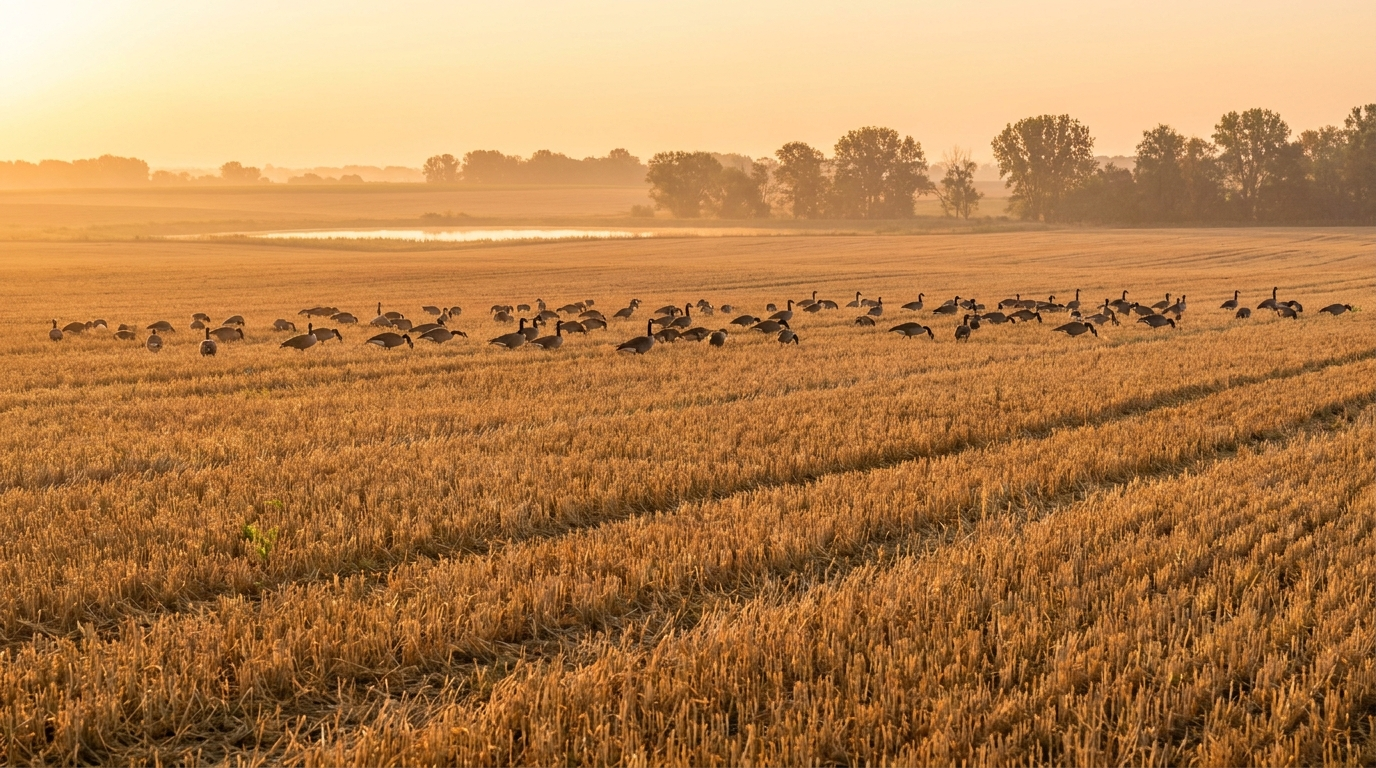
Resident Canada geese don't migrate anywhere in September. That's the entire opportunity of early-season goose hunting, and it's also why so many hunters scout it wrong — they go looking for the birds the way they'd look for migrators passing through on a front, when the geese they're actually after have been loafing on the same pond and working the same three fields since May. Early-season honkers are homebodies. Find where they live and where they eat, and the hunt is mostly already set up.
Resident Birds Don't Behave Like Migrators
The distinction matters because it changes where you spend your scouting hours. Migrators move with weather, cover a lot of ground in a day, and can show up on a field they've never used before. Resident geese raised locally rarely fly more than a handful of miles between roost and feed, and a lot of them will actually walk from the water up into a field edge rather than fly it if the distance is short enough. That means a bird using a farm pond in early September was probably using it in June too, and the neighboring hay ground or small-grain stubble it's been walking to for breakfast isn't a mystery — it's a pattern you can find with a truck, a good pair of binoculars, and a couple of evenings.
Start at the roost. Any pond, stock tank, or slow river stretch big enough to hold forty or more geese overnight is a candidate, and most counties don't have an unlimited supply of them. Work outward in a five-to-ten-mile ring and glass every cut hayfield, harvested small-grain field, or corn stubble inside that radius. Geese loafing on water in the middle of the day and feeding morning and evening is the default pattern through most of early season, so plan your scouting sessions around those windows instead of driving by at noon and assuming nothing's using the field.
Match Your Scouting Time to Your Hunt Time
A field that looks dead at 11 a.m. can be covered in birds by 6:30. Geese frequently split their feeding between a morning field and a different afternoon field, and the two aren't interchangeable — set up on the wrong one and you'll watch birds work a pasture a half-mile away for two hours. If you're building a plan for a morning hunt, scout mornings. If you can only scout evenings before work, don't assume the pattern holds in reverse; verify it, even if that means one more pre-dawn drive before the season opens.
Binoculars do most of the real scouting work here — you're not walking fields and bumping birds off a pattern you're trying to protect, you're parked on a county road reading a flock from four hundred yards through glass. A mid-size 8x or 10x binocular covers this fine; you don't need a spotting scope for field work at this range. If your current pair is a decade-old holdover from truck-glovebox duty, this is a reasonable place to upgrade — check the current optics deals before the season gets busy, since decent glass makes the difference between guessing at bird numbers and actually counting them.
Crop Timing Decides Which Fields Open Up
Early-season field access is a moving target because it's tied to harvest, not to the calendar. Hay ground can be cut and geese can be using it within days. Small grain stubble opens up right after combines roll through, and corn — depending on the state and the season dates you're hunting — may or may not be down yet. Keep a running list of which fields in your five-to-ten-mile ring are cut, which are close, and which still have standing crop, and update it weekly. A field that's off-limits in early August because the wheat's still standing can be the best field in the county two weeks later.
This is also where local knowledge beats a satellite image. Aerial imagery tells you a field is cut; it doesn't tell you it flooded last week from an irrigation pivot, or that the farmer sprayed it and geese are avoiding it for reasons that have nothing to do with hunting pressure.
Drive it. Glass it. Don't trust the map alone.
Ask Before You Need To
The best time to ask permission is before you've found the birds on someone's field, not after. Early-season resident geese do real damage to a hayfield or a stand of soybeans, and plenty of landowners who've never dealt with a hunter showing up cold will happily let someone deal with the geese pulling up their crop. Knock on doors in July and August, ask specifically whether they've had trouble with geese in their stock tanks or field sloughs, and get permission lined up before opening day rather than scrambling once you already know where the birds are and every other hunter in the county has spotted the same field.
Keep it simple when you ask: who you are, what you're hunting, when you'd want to hunt, and that you'll check in before every trip. Most of the doors that say no aren't rejecting you personally — they've had a bad experience with somebody who didn't ask, didn't close a gate, or showed up unannounced at 5 a.m. Be the hunter who doesn't cause that problem and you'll keep that field for years.
Setting Up Once You've Found the Pattern
Early-season geese haven't seen much hunting pressure yet, and that changes how much decoy and calling you need. This isn't the point in the season for a massive spread — two to four dozen decoys set loosely in family groups of six to eight birds, with a few pairs and singles scattered through, reads better to a small flock than a wall of plastic that outnumbers anything they've actually seen on that field. Match your spread size to what you counted while scouting; if the field's been holding sixty birds, decoying for two hundred just looks wrong to the geese you're actually trying to fool.
Calling works the same way. If your scouting was accurate and you're set up in the exact spot birds have been using, the job is to close the deal quietly, not to demonstrate a full repertoire. Early birds haven't been called at by six different hunters yet — they're not call-shy, but they are pattern-sensitive, and a spread and call sequence that oversells the moment can put them on edge before they're in range. If you're still building out a call lineup or replacing something that quit working last season, that's worth sorting out well before the opener rather than the morning of.
Concealment matters more on field hunts than a lot of hunters expect walking in from duck hunting. A layout blind that's the tallest thing in the field by even a couple of inches reads as wrong to a bird approaching from altitude, and a stubble field offers a lot less natural cover than a slough edge does. If you're shopping for field blinds or brushing material, look at the current blind selection before you're improvising with a tarp on opening morning.
Gear for Warm Mornings, Not Cold Ones
Early-season goose hunting runs warm across most of the country — mornings in the 50s and 60s in the northern tier, well into the 70s farther south, and that changes the clothing calculus completely from the December hunts most waterfowlers picture. A heavy insulated parka is the wrong tool here; you want breathable, lightly insulated layers you can shed fast once the sun's up and the walk back to the truck starts. Technical layering pieces from brands like Sitka handle that swing well, and Drake Waterfowl's lighter early-season lines are built around exactly this problem instead of assuming every hunt is a January layout-blind sit. Both brands run deep discounts through the clothing and jacket categories worth checking before you buy something built for the wrong month.
Boots matter less here than in duck hunting — a lot of early goose work is dry-field walking rather than wading — but don't assume that means any boot will do. A stiff, insulated wader boot on a mile-long walk into a stubble field in 70-degree heat is a miserable decision you only make once.
Running Traffic as the Season Moves
Spot-and-decoy-the-X works best in the first couple of weeks, while resident birds are still tight to a small number of fields and predictable feeding windows. As the season progresses and more ground opens up post-harvest, birds spread across more fields and traffic patterns start to matter more than any single X. That's when a bigger decoy footprint aimed at pulling attention from birds working toward a different field starts to outperform a tight, realistic spread built to fool birds already committed to your exact spot. Recognize the shift instead of running the same early-season playbook into October and wondering why the numbers dropped off.
Scouting early-season geese isn't complicated, but it rewards the hunter who does it in July and August instead of the week before the opener. Find the roost, read the feed rotation, get permission locked down, and match your gear and setup to birds that haven't seen pressure yet. For everything else on the list — optics, blinds, calls, and the layers that actually make sense for a warm-morning field hunt — the full lineup of live waterfowl deals is worth a look before the season gets moving. Pair the scouting work here with a solid read on how to choose a layout blind for field goose hunting, and if you're chasing an even earlier opener, the tactics in our early teal season guide carry over more than you'd expect.