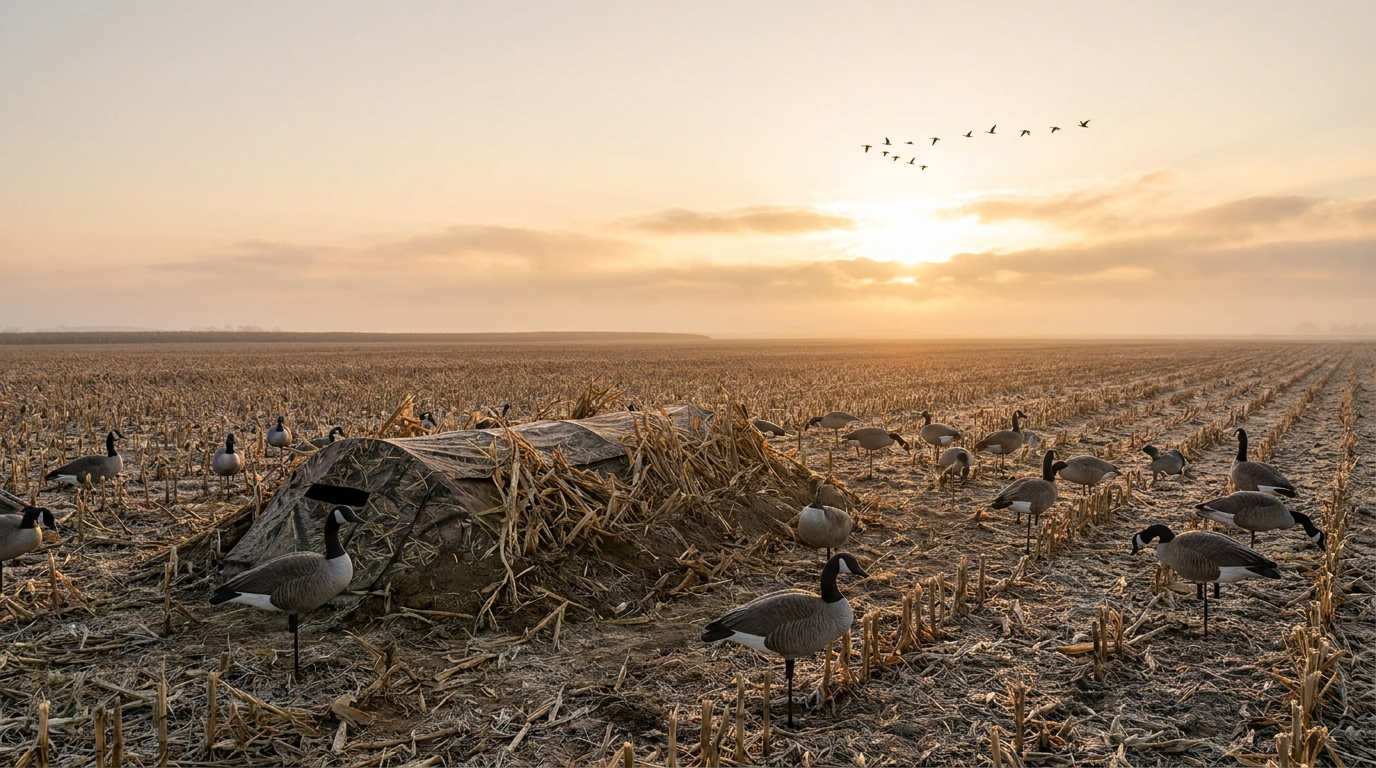
Walk 50 yards downwind of your layout blind setup and look back. If the blind is the tallest object in that field, even by two inches, you've found the same problem geese spot from 200 yards at altitude.
That single metric matters more than brand, camo pattern, or price. Everything else in the buying decision flows from whether you can keep your blind below decoy height once it's fully stubbled in. Most hunters get this backwards, choosing blinds for looks in the catalog and discovering the profile problem on their first field goose hunt.
Profile Height Is the Only Number That Matters
Full-body Canada goose decoys on standard field stakes sit 14 to 18 inches off the ground. Your layout blind, once stubbled, should clear that by no more than two inches. Not "roughly similar." Two inches.
Geese at altitude read silhouettes, not camo. If your blind profile is the tallest object in the spread, even by a small margin, they identify it as an anomaly before they're in gun range. At that point the Realtree MAX-7 fabric does nothing for you. They've already catalogued the location and decided to work the field 300 yards east.
The Avery GHG Ground Force is specifically marketed as the lowest-profile frame-style blind available, and that's why experienced field hunters treat it as the comparison baseline rather than the Finisher. The Finisher (18 lbs, aluminum frame, 80 inches long) is the industry standard for good reason, but hunters on heavily pressured fields (late season, educated birds that have worked a spread twice before) start trending toward lower-profile options. Dive Bomb Industries builds their layout blind around this problem specifically, treating concealment geometry as the design priority rather than an afterthought.
Weight and the Decision to Move
Layout blind weight has one real consequence: whether you can make multiple moves in a day without leaving equipment behind.
Field geese are spatially unpredictable. You scout the exact feeding zone two days before the hunt, set up in the dark, and they pitch 200 yards short or drift left of your spread. If your blind weighs 32 lbs and you have four of them, you're committed to that spot. If it weighs 11 lbs, you pull stakes and relocate in 10 minutes.
The Avery Power Hunter (11 lbs) is built for mobile hunters who expect to move. The Avery Finisher (18 lbs) is the settled-crew standard: you're driving to the field, committing to a location, and relying on scouts. Most field hunters fall somewhere in between.
Tanglefree has built a genuine reputation in the mid-weight range. Their Landing Zone gets cited consistently on goose forums as producing Avery-comparable field performance at a lower price point. The setup-and-teardown mechanics are clean, which matters more than it sounds when you're packing out in the dark at the end of a hunt.
What Concealment Actually Means in Practice
Factory camo pattern accounts for roughly 20% of your concealment outcome. Most hunters treat it like it's 80%.
The honest breakdown, based on how setups actually fail:
- Stubble application and local color matching: roughly 40%
- Mud treatment and shine reduction: roughly 25%
- Profile height and placement: about 15%
- Factory camo pattern: roughly 20%
Before any blind reaches a field, you need to know what color the local stubble is. A harvest-tan blind in dark, weathered corn stubble creates a visible mismatch from 100 yards regardless of how much material you've applied. Realtree MAX-7 (the pattern on several Avery, ALPS, and Banded models) was designed specifically for ag fields, incorporating cracked mud backgrounds and milo tones rather than standard woodland imagery. But even MAX-7 doesn't save a blind that hasn't been mudded.
Mudding: a bucket of black dirt mixed to paste with water, applied to all fabric surfaces, then allowed to dry overnight. This kills the factory shine on cordura that reflects sunlight at long range. Skip this step and you'll add it permanently after your first blown setup.
Apply stubble to the entire blind, not just the lid. This is the single most common mistake. Walls, frame edges, and corners stay exposed while hunters concentrate on the top panel, and the residual frame geometry reads to geese at 75 yards. After setup, walk 50 yards downwind and evaluate from the approach angle. Look for geometric shapes, color inconsistencies with surrounding stubble, and any surface casting an unnatural shadow.
Frame and Construction Specs
Aluminum frames are standard at mid-range price points. They handle moisture, survive field transport, and hold up through multiple seasons of normal use. Steel frames are heavier but handle sustained wind better with less flex and noise.
Fabric specs that matter: 1800-denier polyester on the floor for direct contact with wet soil and gravel, 900-denier polyester on the body and lid. PVC-coated seam-taped lower fabric prevents moisture wicking through seam perforations in wet early-season or snow.
Stubble straps are worth evaluating before you buy. Straps should hold natural material from multiple angles without releasing in damp conditions or vibrating audibly in wind. Blinds that look nearly identical on paper can differ significantly here, and you find out at 5 a.m. in November.
Placement: Where Hunters Lose Birds the Blind Didn't
The right blind set up in the wrong spot produces worse results than a budget blind set up correctly. Four placement rules experienced field hunters don't skip:
Wind orientation. Blinds go head-to-feet with the wind, so geese, which land into the wind, approach over your feet and commit directly in front of your face. Reverse this orientation and birds come over your back. The shooting angle becomes awkward and they see your face on approach.
Get to the X. Canada geese feeding in a cut cornfield operate on spatial memory accurate to 30 or 40 yards. Setting up 200 yards from where you watched them feed is functionally hunting the wrong field.
Don't stack blinds in a row. Two or three blinds can be concealed effectively. Four or more, evenly spaced in a line, create a geometric alignment that geese recognize at altitude even without identifying any individual blind. If you're hunting a group, stagger pairs in a rough arc around the landing zone rather than a straight file.
Blind spacing. Four to six feet between individual blinds for shooting arcs. Tighter than that and you can't swing without flagging your neighbor.
What to Wear Inside
Being flat on your back in a cold, wet cut cornfield for four hours is harder on your body temperature than most elevated setups. The ground draws heat from below faster than wind does from the side, and it's a slow drain you don't notice until you can't feel your feet.
Waders perform better than most hunters expect in layout blind hunting. The waterproof shell handles ground moisture, and insulated chest wader options provide the thermal barrier the position demands. Drake Waterfowl Insulated Guardian Elite HND Front Zip Waders use a front zip that makes entry and exit practical in the dark, a detail that sounds minor until you're doing it every morning at 5 a.m. TideWe DeepWade breathable chest waders regularly run at a steep discount and make sense for hunters who run warm or are hunting warmer early-season birds before temperatures drop.
For a more stationary field setup, Banded Waterfowl Field & Suite Blind is designed for semi-permanent field use with multiple shooting positions and a larger footprint. Less mobile than a standard layout, but practical for a consistent morning-after-morning setup on the same permission all season.
What to Browse Now
The layout blind market has settled into a few honest tiers. Avery, Tanglefree, and Dive Bomb are all producing field-worthy blinds at different price points. The performance gaps are narrower than brand marketing suggests. A well-set-up mid-range blind in the right spot will outperform an expensive blind with poor stubble application on every hunt.
Browse current field blind deals as inventory moves heading into season. The pricing worth watching: aluminum-frame mid-weights from Banded, Dive Bomb, and Tanglefree. Avery-equivalent construction at Tanglefree pricing shows up less often than Avery clones at Avery prices, and when it does, it moves fast.
Everything for the full field goose kit is tracked live at Duck Blind Deals.