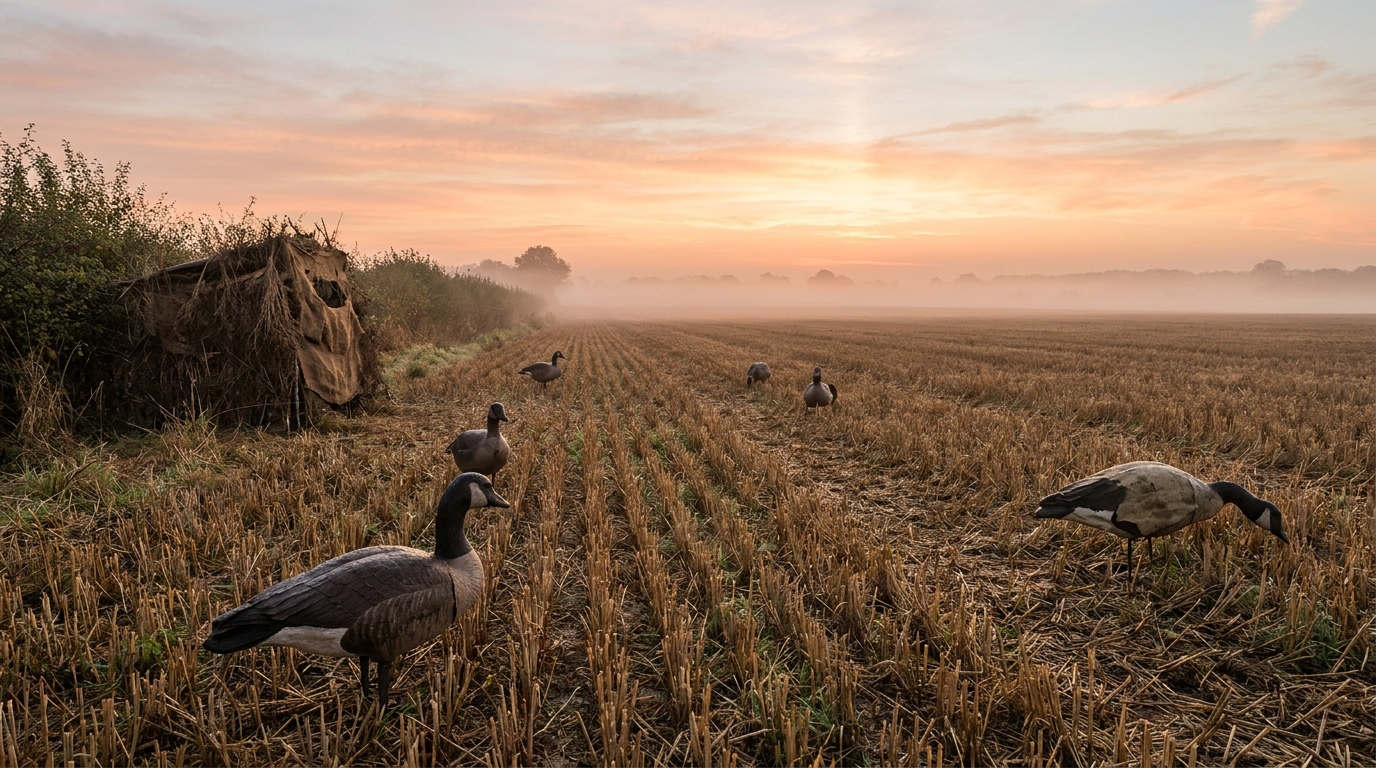
Resident Canada goose numbers have passed three million birds nationwide, and roughly eight in ten geese decoying into a September field this year have never seen a shotgun. That's the whole opportunity of early goose season, and it's also the reason a lot of the spread advice floating around right now is wrong for the birds you're actually hunting.
The late-season playbook doesn't apply here
Open any general goose-hunting guide and the decoy math tends to run the same direction: more is better. Six dozen. Ten dozen. A rig big enough to be visible from two miles up, because that's what it takes to pull a flock of pressured, migrated-in honkers that has already been shot at three states north of you. That advice is correct — for December geese.
September birds are a different animal, and not just in plumage condition. They're local. Most of them hatched within a few miles of the field you're hunting, in a family unit of two adults and that year's brood, and they've spent the summer loafing on the same pond and feeding the same crop stubble without a decoy spread or a blind ever entering the picture. Setting a rig built for wary, flock-hardened migrators in front of birds like that isn't just unnecessary — it can actively spook them. A spread that's too big, too dense, or too uniform reads as unfamiliar, and unfamiliar is the one thing a local goose that's never been shot at will flare from on instinct.
What an early spread should actually look like
Two to three dozen full-body decoys is the real number for a September field hunt, not six or ten. Break that total into four or five separate pods of six to ten decoys each, spaced ten to fifteen feet apart across the field — not one solid block. Each pod should mimic an actual family group: within it, keep decoys close, two to three feet apart, with feeders outnumbering upright "sentry" heads by roughly three or four to one. Real geese spend most of a feeding session with their heads down; a spread where every decoy is standing tall and alert looks like a flock that's already nervous, and incoming birds pick up on that before they're in range.
Leave the landing zone open. A wide, shallow U with a clear twenty-yard gap in the middle, set roughly fifteen yards off the blinds, gives birds a lane to commit to instead of a wall of plastic to work around. That gap matters more than the decoy count does. A hunter who's scouted the right field and set eighteen decoys in loose family pods with a clean landing zone will out-shoot a hunter who dumped six dozen decoys in a tight horseshoe on the wrong forty acres, every time.
Scouting still wins the morning
None of that spread math matters if you're not sitting on the field the birds were using yesterday evening. Early-season Canadas are creatures of habit before hunting pressure ever teaches them otherwise — same roost, same loafing pond, same feed field, on a schedule you can set a watch to. Two evenings spent glassing flight lines from a truck, well back and out of sight, will tell you more than any decoy purchase will. If you can't get on the exact field, get on the flight path between the roost and the field and let geese work a smaller, simpler spread on their way through instead of fighting them for a destination they've already picked. A more detailed early Canada goose scouting plan is worth reading in full before opener if the pattern isn't dialed in yet.
Watch for the field to go quiet, too. A field that produced birds for a week straight and suddenly stops isn't cursed — the flock likely shifted to a fresher food source nearby, and re-scouting for a day beats sitting a dead field out of stubbornness.
A realistic September morning, hour by hour
A hunt built on scouting instead of decoy volume tends to run on a tight, boring clock. Arrival by 4:45 a.m., an hour before legal shooting light, leaves enough time to brush the blinds into standing cover without a headlamp beam sweeping the field. Decoys go out next, pod by pod — not scattered by the armful — and the whole two-to-three-dozen spread should be down and settled by 5:30, a solid thirty to forty minutes before the first birds are likely to lift off the roost. By 6:00, with legal light close, the blinds are brushed, the guns are loaded, and everyone is still. Geese that left the roost at first light are typically over the field by 6:15 to 6:45 on a normal morning, feeding hard for the first hour before the pace slows. Most of the actual shooting on a well-scouted field happens in that first 45-minute window — which is exactly why the setup has to be finished with time to spare, not rushed at the last minute while the first flock is already circling.
Call soft, not hard
Early-season family groups aren't fighting for territory or trying to pull in a whole flyway's worth of geese the way late-season hunters sometimes are. They're talking to each other at conversational volume — clucks, murmurs, and soft moans, not the loud, aggressive hail calls that get pulled out for distant migrators. Save the big-lunged calling for birds that are still working at three hundred yards and need to be turned. Once a family group commits and starts working the spread inside a hundred yards, drop the volume and feed them soft feeding chatter instead. Overcalling close-in birds that are already coming is one of the more common ways to put them back up in the air with nothing to show for it.
Gear that matters more in September than December
Standing crops are still up in most early goose country, which changes what actually conceals a hunter. A natural-cover layout blind brushed with material from the field itself does more work here than a heavy white-front-pattern blind built for open, harvested ground later in the season — layout blinds worth checking for field cover are worth a look before opener, especially if your current one is still dressed for last year's stubble. This layout blind buying guide breaks down the profile and brushing differences that matter most for standing-crop hunts specifically. A short-reed goose call built for soft, close-range work matters more right now than one tuned for max volume at distance; goose calls built for that range of tone are worth the upgrade if yours only does loud. Round it out with a decent stake bag and a field cart, since hauling four pods of decoys across a quarter mile of stubble by hand gets old fast — field accessories covers the stake bags, cords, and carts that make the setup and teardown faster.
When to scale the spread back up
This isn't permanent. As the season moves into October and November and migrators start filtering down from the north, the birds you're hunting get progressively more pressured and more wary of small, static spreads. That's when the bigger rigs, the motion decoys, and the louder calling earn their keep again. But for the first several weeks of the season, while you're hunting geese that grew up within sight of the field, restraint beats volume. Set fewer decoys in the right spot instead of more decoys in the wrong one.
Early goose season doesn't reward the hunter with the biggest trailer. It rewards the one who scouted hard enough to know exactly where to put a smaller, more believable spread — and who resisted the urge to treat a flock of unpressured local birds like they'd already been shot at. For everything else on the list before opening morning, the current waterfowl deals are a good place to start.