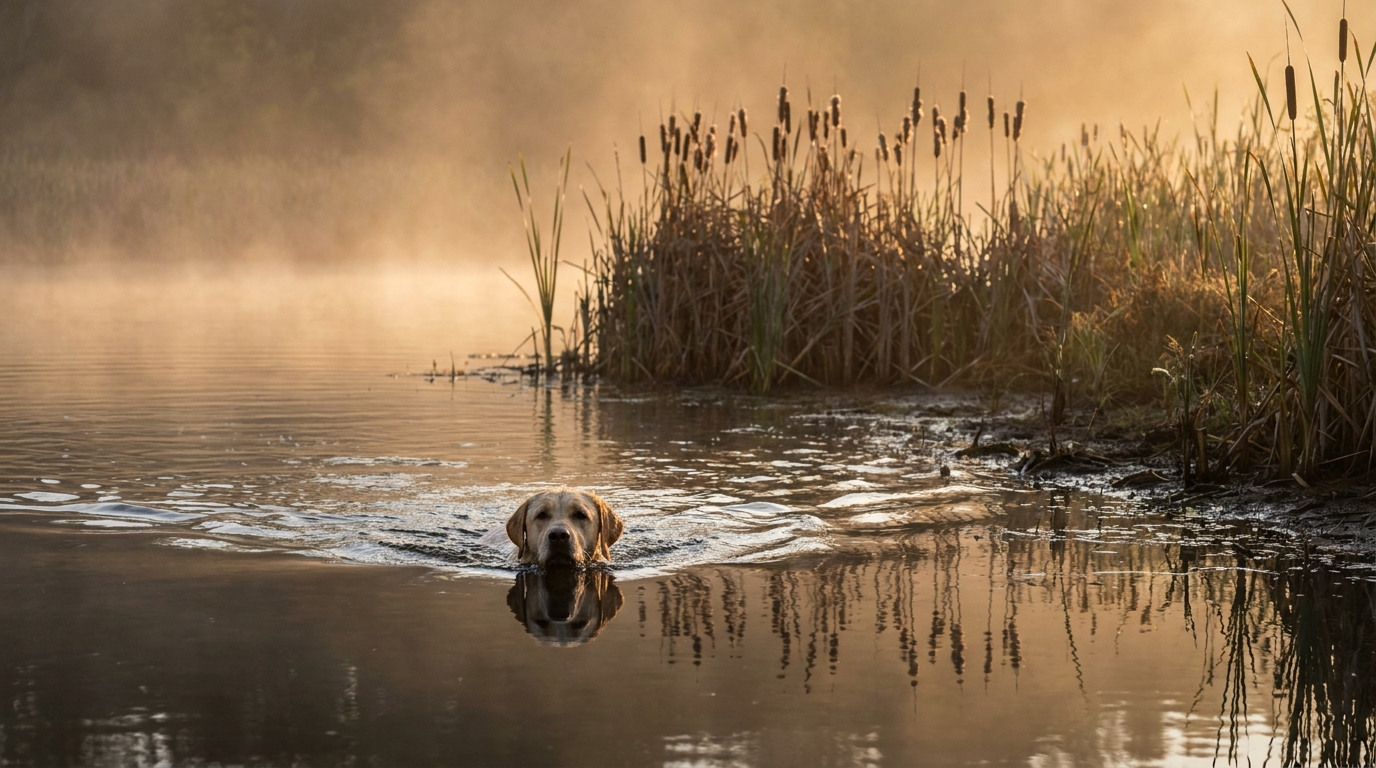
By the second week of July, most retrievers haven't swum farther than the width of a farm pond since late January. That's normal. It's also why so many duck dogs show up to opening day twenty pounds over their hunting weight, blowing hard after the third retrieve, and flinching at a shot they used to shrug off. A dog doesn't lose conditioning as fast as a person does, but eight months of couch time and backyard fetch is not the same animal you need in a boat at first light in October.
The good news: you have time right now to fix all three problems — fitness, heat tolerance, and gun sensitivity — without wrecking a joint or melting a dog in July heat. The bad news: it takes longer than most people plan for, and doing it wrong (too much, too fast, in the wrong part of the day) causes real injuries. Here's a plan that works with the calendar instead of against it.
Start with an honest weight and fitness check
Run your hand along the dog's ribs. You should feel them easily without digging through fat, and there should be a visible waist when you look down from above. If you can't find the ribs without pressing, the conditioning plan starts with weight loss before it starts with distance work — an overweight dog in a boat all day is a heat-stroke and joint-injury risk before the season even gets hard.
Check the pads next. Winter and spring don't toughen pads the way a season of hunting does, and soft pads tear on rock, ice-crusted mud, and cattail stubble. If the pads feel smooth and soft rather than firm and slightly calloused, they need weeks of surface-varied walking to harden up — not a sudden week of hard retrieves right before the opener.
Build fitness before you build distance
Start with 15- to 20-minute walks four or five days a week, and add swimming as soon as water temperatures make it comfortable. Swimming is close to ideal for this phase: it builds cardiovascular fitness and muscle without pounding joints on hard ground, and it happens to be the exact skill the dog needs most.
Resist the urge to run long retrieves this early. A dog that's out of shape and overheated on a 150-yard summer retrieve isn't building toward the season — it's building a bad association with retrieving and, in bad cases, ending up at the emergency vet. Keep retrieves short (20 to 40 yards) and frequent rather than long and rare, and use the extra time for the stuff that doesn't require distance: heeling, "sit," "stay," and steadiness at the line. A dog that breaks on the shot in July will break on the shot in October if nobody fixed it.
Over six to eight weeks, extend the walks, add hill or levee sections if you have them, and let swim sessions run longer as the dog's fitness allows. By week six or seven you should see a dog that finishes a training session breathing hard but recovering fast — not one that's still panting heavily ten minutes after you've stopped.
Respect the heat — it kills dogs faster than owners expect
Summer is the most dangerous season to condition a retriever, which is a strange thing to say about the time of year with the most daylight to train in. Dogs cool almost entirely through panting and a little through their pads, and a dog working hard in July can go from fine to critical faster than most people believe.
Train early — before or right at first light, while there's still dew on the ground — and quit by mid-morning once the pavement and open ground start radiating heat back up. Watch for heavy, labored panting, a low or tucked tail, flattened ears, or a dog that starts dragging its hind legs. Any one of those is a stop-training signal, not a push-through-it signal. Full heat stroke shows up as loud, frantic breathing, a bright red tongue, and vomiting — a dog's normal temperature runs around 101 to 102°F, and once it's pushing 106°F you're in an emergency: cold water immersion or a garden hose, and a vet, immediately.
Warm, stagnant water carries its own summer risk that has nothing to do with heat exhaustion — blue-green algae blooms show up in ponds and slow water all summer and can be fatal if a dog swims through it or licks its coat afterward. If a pond looks like pea soup or has a visible scum on the surface, find different water.
Get the dog's ears back under a gun
A retriever that hasn't heard gunfire since last season is not automatically going to be fine with it in October — plenty of dogs that hunted confidently all last year come out gun-shy after a long off-season, especially young dogs with limited reps. The fix is the same gradual process you'd use on a green dog, just compressed: start with a blank pistol or popper load at 30-plus yards while the dog is doing something it loves — chasing a bumper, eating, playing — so the sound gets paired with something good, not something scary.
Every shot should come with a retrieve attached, never gunfire in isolation. Over several sessions, close the distance and step up to louder loads, watching the dog's body language the whole time rather than following a fixed schedule. A dog that flinches, freezes, or won't take the next retrieve needs to back up a step, not push through it. Do this in multiple short sessions across a couple of weeks rather than one long session — dogs that hear a lot of gunfire packed into a single day condition worse than dogs that get spread-out, positive reps.
Rebuild the situational stuff, not just the physical stuff
Fitness and gun tolerance solve half the problem. The other half is that a dog who hasn't seen a spread, a blind, or a call in eight months is going to be distracted by all of it on opening morning instead of focused on the sky. Set up actual decoys, throw a dummy from inside a layout blind or an A-frame, run a check cord through brush the way you would along a slough edge, and let the dog get bored of the gear before it matters.
Memory marks are worth rebuilding too — a simple single mark, walked to calmly, repeated with increasing distance over a couple of weeks, resets a skill that erodes faster than people expect during a long layoff.
Check the gear along with the dog
While you're rebuilding the dog, walk through the hardware. E-collar batteries and contact points corrode over an off-season in storage — charge and bench-test the unit, and check the fit before you need it in the field; Dogtra's collar lineup runs deep discounts right now if the old one's contacts are shot. Whistle and check cord discipline both fade during the off-season faster than the dog's fitness does, and Mendota's slip leads and check cords are worth having a spare of before a frayed one lets go at the worst moment.
If gunfire conditioning or a dummy launcher is part of your plan, D.T. Systems covers both training collars and launcher setups, and their site has a straightforward walkthrough of gradual gunfire introduction that's worth reading before you start. For the dog's own gear — vests, travel crates, blind bags — Boyt Harness carries the kind of duck-dog-specific hardware that doesn't show up in a general pet aisle, and it's currently discounted across several pieces.
Beyond the dog-specific stuff, this is also a good window to get your own training and field accessories sorted — checkcords, dummies, and the small gear that always seems to be missing a piece by the time September rolls around.
Work backward from opening day
Give yourself eight to ten weeks minimum if the dog spent the off-season mostly idle. That's roughly today if you're reading this in early July with a September teal or goose opener in mind, or a little more breathing room if your main season doesn't start until October or November. Weight and fitness come first because everything else is safer once the dog isn't overheating on light work. Gunfire and situational training layer in around week three or four, once the dog has some conditioning to fall back on. The last two weeks before the season should look almost exactly like a hunt — decoys out, blind set, gun present, dog steady — so the only new thing on opening morning is live birds.
None of this needs to be complicated, and none of it needs new gear to start — a check cord, a dummy, and a stretch of safe water covers the first three weeks. It just needs to start now instead of the week before the season, which is when most of this conversation usually happens for the first time. If you do end up needing to fill gaps in the kit before then, the wader care guide is worth a read too — a dog in good shape and a hunter in wet gear that's already failing is still a bad opening morning. Same goes for anyone gearing up for an early teal opener: the conditioning timeline above applies just as much to a September hunt as a November one, just compressed.
Start the walks this week. Everything else on this list gets easier once the dog is actually in shape to do it — and once you're there, the rest of what's on sale right now is a lot more useful than it would've been in April.