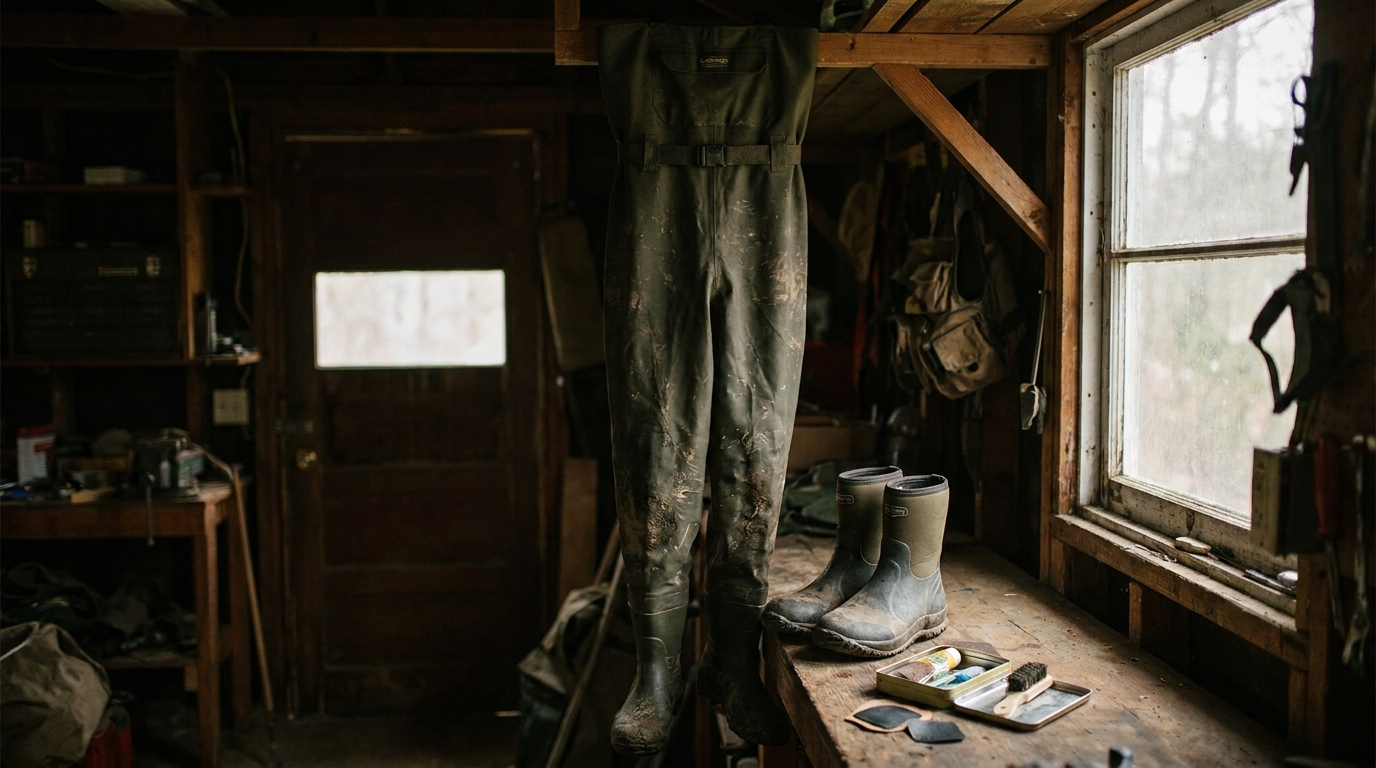
Breathable waders don't usually fail because the membrane gives out. They fail because the face fabric gets contaminated with body oil, decoy slime, and a few seasons of agricultural runoff, the DWR coating never gets refreshed, and they spend seven months compressed in a plastic bin in a hot garage. The membrane is fine. Everything around it gets wrecked.
The fix isn't complicated, but the timing matters. A fifteen-minute routine after each hunt and a proper end-of-season wash adds years to a pair that would otherwise start leaking in year two.
---
After Every Hunt: Rinse While They're Still Warm
The worst move is peeling off your waders, rolling them up wet, and throwing them in the back of the truck. Duck water — especially in flooded timber, rice fields, or any agricultural drainage situation — carries petroleum residue, organic matter, and everything waterfowl add to it. That sits in the wader fabric until you rinse it out. It doesn't evaporate. It sets.
Rinse the outside while you're still wearing them if a hose is available. When you get home, flip them inside-out and rinse the interior. The booties are the worst spot. Sweat and condensation pool there, and if you leave them damp they'll start to smell within a week and grow mold in the seams.
Hang them by the boot soles in a ventilated space. Breathable waders dry faster inside-out; the membrane and lining need airflow just as much as the face fabric. Neoprene takes longer — 24 hours minimum before you roll them up, more in humid weather.
Don't hang either type in direct sunlight for extended periods. UV degrades neoprene rubber measurably over time and can break down seam tape adhesives on breathable waders. Shade and airflow is the combination you want.
---
Washing Breathable Waders: The DWR Is Everything
The clammy, wet-from-the-inside feeling that hunters blame on a failing membrane is almost never the membrane. It's the DWR — the durable water-repellent coating on the face fabric — failing to bead water off the outer shell. The shell wets out and feels cold and saturated even though the waterproof barrier underneath is still intact. You're wet from sweat and wet from outside simultaneously, and both feel the same.
DWR fails for two reasons: contamination (body oils, sunscreen, boat fuel, mud) and abrasion from blind seats, boat gunwales, and thorny cover. Washing removes the contamination. Re-treating restores water repellency. You need to do both.
For washing, use Nikwax Tech Wash or Revivex Synthetic Fabric Cleaner. Standard laundry detergents — even gentle ones — leave surfactant residue that attacks DWR. Fabric softener is worse; one wash with it can permanently degrade the face fabric coating. Gentle cycle, cold water, double rinse. A front-load washer is better than a top-loader with an agitator, which stresses seam tape.
Wash every 10-15 days of field use, or at least once at the start and end of each season. Hunters who are on the water October through January should plan on a mid-season wash as well.
After washing, apply Nikwax TX.Direct Wash-In during the final rinse cycle, or spray Revivex Spray-On Water Repellent on the outside while the waders are still damp. Then activate it with heat: 20 minutes in the dryer on low, or go over the face fabric with a hair dryer. Heat is what bonds the DWR molecules to the fabric. Skip this step and the treatment won't set properly — you'll be standing in a flooded blind two weeks later wondering why water isn't beading.
A properly treated wader sheds water hard. If yours are wetting out after a fresh DWR treatment, check whether the face fabric has abraded through in the high-wear spots: inner thighs, knees, around the boot. Heavy abrasion means re-treating has limited effect. That's a face fabric problem, not a membrane problem, and it signals the outer shell is reaching end of life.
---
Neoprene Waders: Different Problem, Different Fixes
Neoprene waders — the 3.5mm and 5mm rubber suits that dominate cold-water and late-season hunting — don't have a DWR problem. Their waterproofing is the neoprene itself. But the failure modes are their own.
The seams go first. Glue and tape holding neoprene panels together gets brittle with age and UV exposure. Before each season, hold your neoprene waders against a bright light and look for gaps or lifted tape on the interior. Small openings that look like nothing will leak badly in cold water. Aquaseal FD (a flexible urethane sealant) is the right fix: clean the seam with rubbing alcohol, work a thin bead into the gap, and let it cure 8-12 hours.
Compression is the other killer. Neoprene that sits folded tightly at the knee or waist for six months will crack at those creases. Hang neoprene waders full-length during storage if you have the space, or roll loosely without sharp folds. This single storage mistake accounts for more failed neoprene waders than seam failures or punctures combined.
UV exposure matters more than most hunters expect. Keep neoprene covered on the boat when you're not wearing them. Some hunters apply 303 Aerospace Protectant to the outer surface once a season to slow UV and ozone degradation. Old chest freezers, certain fluorescent lights, and electric motors all off-gas ozone, which attacks rubber — worth knowing if you're storing waders in a garage workshop.
---
Finding Leaks Before They Compound
A pinhole leak in October is a cold foot for one hunt. That same pinhole, run through a full season without attention, turns into a 4-inch delaminated patch by January. They don't stay small.
The bucket test is reliable for breathable waders: cinch the waist tight, fill from the top with a few inches of water, let them sit three minutes, and look for damp patches spreading on the outside. Mark the spots with a grease pencil or tape while still wet. For neoprene, slowly compress the fabric while holding it against a bright light — pinholes show as points of light, or you'll hear a faint hiss.
Aquaseal FD handles most repairs on both types. Clean the area with rubbing alcohol, apply a thin coat, feather the edges out about a half inch, and cure fully before getting back on the water. For larger neoprene tears, Gear Aid's iron-on neoprene patches take about three minutes with a household iron. For seam leaks on breathable waders — the most common source of cold-water intrusion — use a dedicated seam sealer rather than Aquaseal, since it's thinner and wicks into the stitching holes properly.
For diagnosing breathable waders: if you're wet on the inside and DWR re-treatment doesn't fix it, the problem may be membrane delamination rather than a leak. Gently flex the fabric and look for bubbled or wrinkled areas inside. Delamination isn't repairable. But lifted seam tape, face fabric abrasion, and punctures are all fixable. Diagnose before assuming the waders are done.
---
End-of-Season Storage: Where Most Damage Accumulates
Wash breathable waders with a DWR re-treatment before storing them. Run the full seam inspection on neoprene. Don't skip these steps because the season is over — contamination that sits in fabric for seven months sets in differently than contamination that sits for a week.
Breathable waders should hang full-length in a cool, dry space with stable temperature. A basement closet or gear room works. A garage that swings between 20°F and 100°F is hard on seam tape and membrane adhesives over months. Heat cycling, humidity, and UV are the enemies during long-term storage.
Neoprene needs the same: hang full-length or roll loosely, no sharp creases, cool and dry. If you're storing past six months, a light application of neoprene conditioner on the interior keeps the rubber supple. Both types do better in a breathable gear bag than a sealed plastic bin — trapped moisture is what creates mold in boot seams.
---
Most of what kills waders early is a cycle of small neglect: a hunt without a rinse, a season without a wash, six months in a folded heap in a hot garage. Breaking one step in that cycle doesn't do much. All of them together turns a $300 pair of waders into a five-season investment.
When you're ready to gear up for next season or replace a pair that's finally done, check the current duck hunting gear deals at Duck Blind Deals. Banded and LaCrosse both see off-season pricing during the spring, and Sitka's waterfowl waders typically hit their best price in late spring before the fall restock.