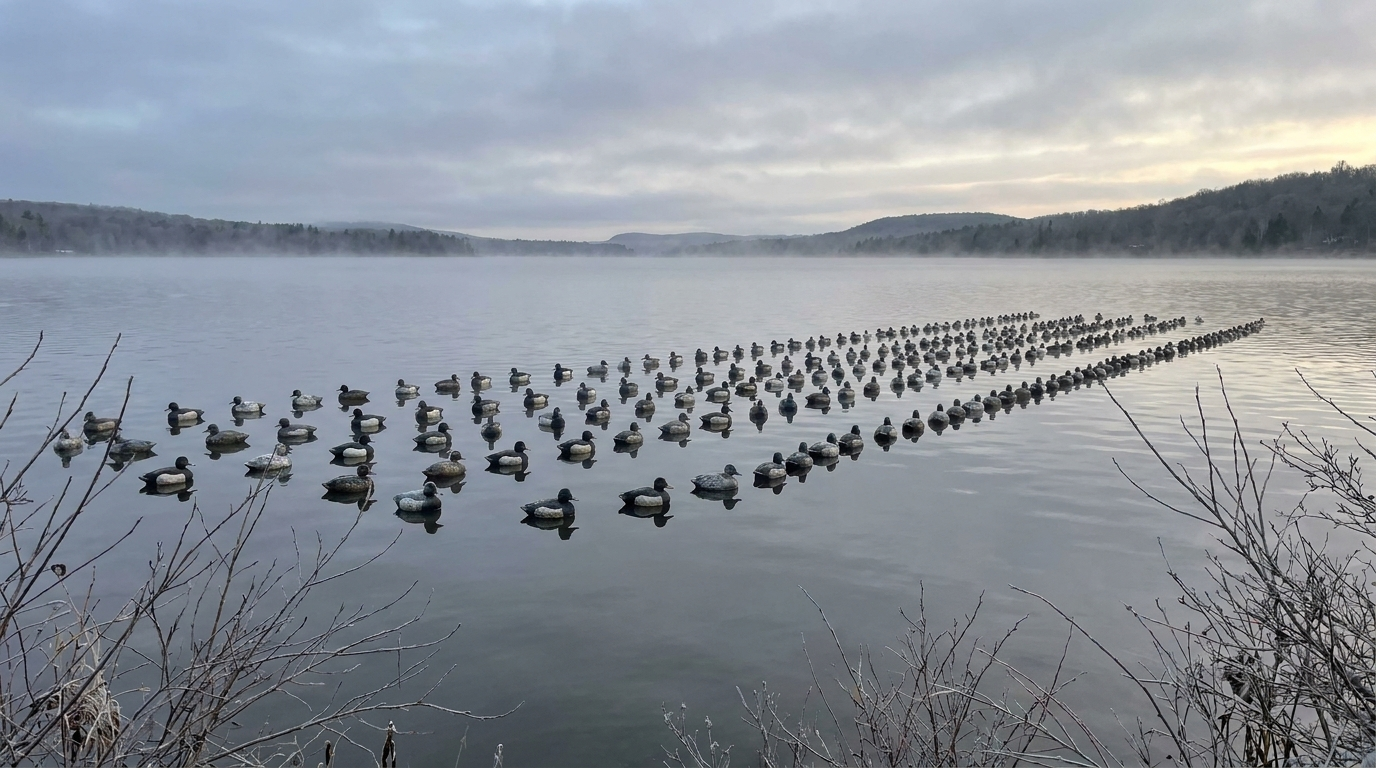
A raft of bluebills on a big reservoir can run into the thousands. Not a figure of speech — actual thousands of birds sitting shoulder to shoulder on open water, riding the chop like it's nothing. That's the visual a diver decoy spread is competing with, and it's why a rig built for six or eight puddle-duck dozens on a beaver pond falls apart the moment you haul it out onto a lake full of cans, redheads, and ringbills. Divers don't work a spread the way mallards and wood ducks do. They fly fast, low, and committed, and they read a fake raft from farther out than most hunters give them credit for.
The gear that makes a diver spread work is different too. This is long-line country — main lines with decoys clipped off at intervals, run in numbers that would take all morning to rig one at a time. Get the hardware and the layout right and you can put out well over a hundred decoys in the dark before shooting light. Get it wrong and you'll spend your first hour untangling instead of hunting.
Why Divers Break the Puddle-Duck Playbook
Puddle ducks work a spread cautiously. They circle, they look, they commit slow. A dozen or two decoys in a family-group cluster with a clean landing pocket is usually enough to seal the deal, because mallards and teal are used to small groups tucked into timber and potholes.
Divers don't operate that way. Bluebills, canvasbacks, redheads, ringnecks, buffleheads, and goldeneyes raft up in the hundreds or thousands on big water, and a small spread just doesn't register as a raft to a flock working a lake at speed. They also approach fast and flat instead of circling high and slow, which means the spread has to do its convincing job in the few seconds a flock has the decoys in view before committing or blowing through.
That combination — needing volume to look believable, and needing the spread to read correctly at speed from a distance — is what pushes diver hunters toward long lines instead of individually anchored decoys. Rigging a hundred-plus decoys one anchor at a time before shooting light isn't realistic. Long-lining is.
Long-Lining: The Rig That Makes Big Spreads Possible
A long line is a mainline — heavy cord with loops or clips spaced along its length — with individual decoys hung off it on short dropper lines instead of each decoy carrying its own separate anchor and cord. Pull the mainline out of the boat, stretch it across the water, drop an anchor on each end, and a dozen or more decoys go out in the time it would take to set two or three on individual rigs.
The basic build: a mainline of #120 tarred nylon twine running anywhere from 50 to 150 feet, with loops tied or brass snaps clipped in every 6 to 12 feet. Off each loop hangs an 18- to 36-inch dropper with a decoy clipped to the end. Anchor each end of the mainline with enough weight to hold in current or wind-driven chop — window-sash weights or comparable poured-lead anchors are the standard, heavier than what you'd use for a single puddle-duck decoy because a dragging mainline drags every decoy on it at once.
Keep the dropper lines short relative to the mainline. Three feet is a common length, long enough that the decoys ride naturally on the surface but short enough that the mainline itself sinks just below the surface between them, out of the way of a working retriever and less likely to foul a prop or paddle.
Materials Worth the Extra Cost
Tarred twine outlasts painted cord and doesn't kink the way plain nylon does after a season of being wound onto a spool wet. Brass snap swivels beat plain clips because they don't seize with grit and corrosion the way stamped-steel clips do after repeated dunking in cold water. None of this is expensive gear individually, but a long line rig that fails at a snap or frays through at a loop in October costs you decoys on the bottom of the lake, not just a few minutes of frustration.
Building the Spread: Rafts, Not Rings
The instinct coming from puddle-duck hunting is to build a tight ring or a horseshoe. Resist it. Diver spreads read better as elongated lines that mimic the shape of a real raft, and running several long lines instead of one dense cluster does two things at once: it covers more visual area with the same number of decoys, and it lets you stagger the lines to fake depth and numbers a single cluster can't.
A workable structure: run two or three long lines of a dozen-plus decoys each, spaced with visible gaps of open water between them rather than packed edge to edge. Toss a scatter of loose singles between and around the lines to break up the mechanical look of parallel rows. From a duck's-eye view at altitude, the gaps and the loose singles read as a raft that's constantly shifting and resettling — which is exactly what a real raft of divers does all day.
The J-Hook and the Kill Hole
The classic diver formation is a J-hook, sometimes called a fish-hook. The bulk of the decoys sit upwind of the blind or boat, forming the body and curve of the J. A single line — the tail — extends downwind from that mass, acting as a runway that guides incoming birds along its length toward the hook at the near end.
The open water inside the curve of the hook, tight to the blind, is the kill hole. Divers naturally want to land on the downwind edge of a raft and swim into the middle, so a tail line pointed into the wind gives them a visual path that terminates right where you want the shot. Set the tail correctly and working flocks will follow it in past the body of decoys instead of flaring around the outside edge, which is the single most common way a promising flock turns into a pass-by.
Wind direction decides the whole layout before you decide anything else. Build the hook with the tail running downwind from your position and the body upwind, and be willing to pick the spread up and rebuild it if the wind swings hard overnight. A gorgeous spread set for yesterday's wind is dead weight on today's water.
Species-Specific Placement
Not every diver species reads a spread the same way.
Bluebills raft in the largest numbers of any diver on the water, so they belong on your longest lines — nothing else carries volume as convincingly. Canvasbacks and redheads show more white and stand out at distance, which makes them worth anchoring the visible edges of a spread even in smaller numbers. Ringnecks work fine in tighter water — sloughs, flooded timber edges, narrow river channels — where hauling out a full big-water rig would be overkill. Buffleheads and goldeneyes decoy better in small, loose knots than in dense lines; a handful of scattered singles near the edges of the main spread reads truer to how they actually sit on the water.
A mixed spread that leans on two or three species patterns, rather than one pattern stretched too thin, does a better job of convincing a flock that's already looking for a reason to keep flying.
Boat, Position, and Reading the Water
Diver hunting concentrates around specific water features more than puddle-duck hunting does: points, current breaks, river mouths where current meets slack water, and the edges of established roost water where birds are already staging. Scout for where birds are actually rafting before you commit to a spot, because divers are far less forgiving of a mediocre location than mallards working flooded timber.
A low-profile boat blind or layout boat matters more here than it does in most puddle-duck setups, since diver hunting frequently happens on open water with no natural cover to hide behind. Anchor the boat itself with the same attention to holding power as the decoy lines — a boat that swings on its anchor mid-flock will blow a group that was otherwise committed.
Common Long-Line Mistakes That Cost Shots
- Undersized anchors. A mainline that drags pulls the whole formation out of shape, and a J-hook that's lost its tail line to current isn't a J-hook anymore.
- Dropper lines too long. Extra slack tangles droppers around each other and around the mainline in any chop, and you'll spend the next morning picking knots apart in the dark instead of hunting.
- Skipping the gaps. A wall-to-wall spread with no open water between lines reads as an unnatural mass. Real rafts have breathing room.
- Ignoring the wind on setup. A hook built for the wrong wind direction doesn't just underperform — it actively pushes working flocks away from your kill hole instead of into it.
Get the mainline hardware right, build the hook to match the wind you're actually hunting, and give the spread room to look like a raft instead of a grid, and diver hunting stops being the intimidating cousin of mallard hunting and starts being the most productive water you'll run all season.
Cold, wet, big-water mornings are hard on gear faster than timber hunting ever is — check current jackets and insulated layers and the decoy hardware, clips, and anchors in waterfowl accessories before the mainlines go back in the boat. Drake Waterfowl and Sitka both run deep discounts on cold-water gear built for exactly this kind of hunting. If you're setting up a boat blind or layout rig for the first time, browse current blinds and layout gear for the concealment side of a big-water setup. For the dabbling-duck side of the spread, see how a puddle duck spread differs from what's covered here, and once the mainlines are rigged and dry, run through our wader care guide so the rest of the kit survives the season as long as the decoys do. Then head back to the current lineup of deals and finish building out the rig.