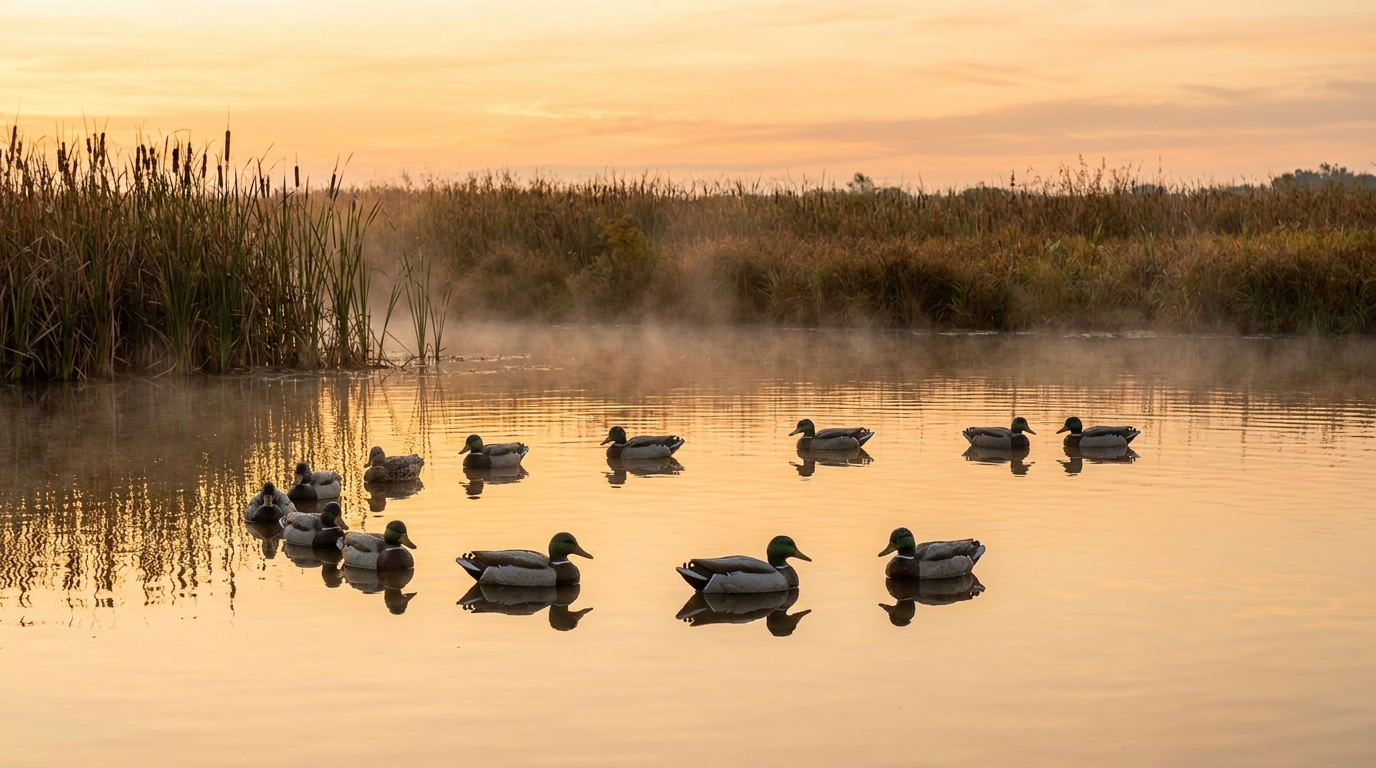
The pocket is everything. You can have 60 decoys on the water and a blind that would fool a biologist, but if you haven't left a clear landing zone in the right spot, ducks are going to swim your spread and keep going. The number of decoys matters a lot less than where you leave the hole.
This is a guide to spread design by formation, water type, and season. Not a generic "use a J-hook and adjust for wind" overview — we're going into why each piece works, when it stops working, and what educated ducks in late November do to your confidence.
Start with Wind — Everything Else Builds From It
Ducks land into the wind. Your blind placement, pocket position, and shooting angle all follow from that one fact.
Position your blind so the wind hits you from a quartering angle — roughly 10 o'clock or 2 o'clock, not dead at your back. Dead behind means ducks appear over your shoulder, turn overhead, and you're shooting through your own backswing. A 15-degree angle off the wind line gives you a clean swing on birds committing into the pocket.
Set your pocket so birds land 20-25 yards in front of and slightly to one side of your blind. Not centered — offset it 10-15 yards left or right. This matters more than most hunters realize: birds on pressured water have learned that a centered landing pocket usually means a duck blind behind it. Move the hole and they lose that pattern recognition.
The Three Formations Worth Knowing
The J-Hook is the standard for open marshes and ponds, and it works because it mimics how ducks naturally drift on water. A string of decoys extends upwind from your blind, then curves back toward you like a shepherd's hook. Incoming birds follow the string and settle into the pocket at the bottom of the curve. Keep the open end of the J into the wind. This is the most forgiving formation when conditions are variable.
The U-Shape works better on larger water — big public impoundments, reservoir flats, open lake bays. Two arms of decoys form a loose horseshoe with the opening facing the wind. Birds sweep around the outer edges and land in the middle. You need 40-plus decoys for the visual mass to look convincing at altitude, but when it works, it pulls birds down from high circles faster than a tight cluster would.
The Split Formation is the call in flooded timber. Instead of a continuous pattern, place the bulk of your decoys upwind of the hole and a small group of 6-8 birds 25-30 yards downwind. Ducks dropping over timber into a hole see the two groups and drift between them looking for a landing spot. That indecision keeps them in the hole instead of flaring back over the canopy. In cypress brakes or flooded oak flats, use larger decoy profiles — Super Magnums or full-body floaters — because standard-sized silhouettes disappear in the surface debris and shadow. Trying to compete on volume alone in flooded timber doesn't work.
The Landing Pocket: Where Precision Pays
A 10-15 yard gap is what you're after. Smaller and birds can't find a landing line; larger and they lose the visual cue that says "active, safe water."
The front edge of the pocket sits 20-25 yards from your blind. On calm mornings, you'll watch birds flare at the last second after an otherwise committed approach. Nine times out of ten, they spotted something inside the pocket — a rope, a motion device placed too centrally, or decoys crowded so tight there's no room to set wings. Keep the pocket clean. Nothing in there except open water.
How Many Decoys — by Water Type
Small marsh potholes and backwater sloughs: 12-18 decoys. More than that looks like a traffic jam. Natural duck groupings on small water are loose, not packed. Twelve deliberately placed decoys beats 50 thrown in.
Open ponds and lakes: 40-70 decoys. You need visual mass to pull birds down from altitude and signal a legitimate resting area. Loose groupings of 8-12 birds spaced 3-5 feet apart beat one big tight raft.
Flooded timber and sloughs: 20-40 decoys in larger profiles. Visibility is limited and birds make fast decisions as they clear the canopy. Larger silhouettes cut through wood debris and choppy surface water where standard-sized decoys disappear entirely.
The consistent finding from guides who hunt many different properties: a well-placed 15-decoy spread on exactly the right water beats a 60-decoy spread on water birds are already avoiding. Scouting beats shopping.
Motion Devices: Know When to Use Them and When to Pull Them
Spinning-wing decoys are effective on early-season birds that haven't been shot at. Place them at the upwind edge of your landing pocket — not the center, because ducks avoid flying directly over spinning blades to land. Turn them off when birds are within 100 yards and committing. A spinner that keeps running through the final approach flares more ducks than most hunters admit.
By late November on public water, spinners are actively counterproductive. Birds associate the flash with the first three weeks of season when they got shot at. Leave the spinner in the truck or swap to a jerk rig.
Jerk rigs — a string of 3-6 decoys on a bungee cord anchored to the bottom — create subtle ripple and swimming motion without the flash. Pull the cord from inside your layout or boat blind with a slow, gentle tug every 20-30 seconds. The motion resembles ducks shifting around while feeding, which reads as natural to incoming birds. These work all season, including on ducks that have seen every spinner on the county water. Check current deals on motion decoys and accessories if you're looking to add a jerk rig before the season.
On calm days, both tools matter more. A spread of still plastic on glass-flat water looks exactly like what it is. One jerk rig is often the difference between birds committing and birds circling twice and leaving.
Species Adjustments That Change Your Setup
Mallards are the most forgiving. Drakes naturally spread wide while hens cluster, so place hen decoys near the pocket center and scatter the drakes toward the outer edges. Mallards will land within your spread.
Teal are different — they land outside your decoys, not in them. This changes everything about pocket positioning. Give yourself a wide buffer zone beyond the edges of your spread for the actual landing zone. Tight raft formations work for teal since they bunch naturally, but account for the fact that birds will hit the water 10-15 yards short of your decoy cluster. A teal-specific whistle call is worth having for September season; a mallard call on September teal won't move them the same way.
Wood ducks want their own small setup in timber — 2-6 decoys, placed within 10 feet of brush or standing timber. Don't mix woodies in a tight cluster with mallard decoys; they run in separate groups naturally. Use subtle motion only. Spinners flare them consistently.
Late Season: Reverse Almost Everything
After three to four weeks of hunting pressure, duck behavior shifts. Ducks Unlimited research documents decoy avoidance increasing 40-60% on heavily hunted marshes by mid-season. What worked in October reads like a warning sign in December.
Three specific adjustments that work:
- Cut the spread to 6-12 decoys on secluded water, away from the spots every other hunter is working
- Drop the spinner; use only a jerk rig on still mornings
- Pull back on calling — a few notes on a greeting call, not the aggressive cadence that worked when birds were still traveling and hadn't been shot at
Some guides go all-Canada goose decoys on pressured duck holes for the final few weeks. The unfamiliar profile breaks the pattern birds have learned. Strange-looking, but it works.
What Makes Spreads Fail
No pocket, or a pocket too small. Ducks can't commit if there's nowhere obvious to land.
Decoys too close together. Two-foot spacing looks like birds in distress. Open water needs 3-5 feet between decoys; even on small marsh, 2-3 feet minimum.
Landing zone centered directly in front of the blind. Works on unpressured birds. Late-season birds read it and flare at the edge.
Motion device in the center of the pocket. Birds try to avoid landing on the spinner and break off.
Spread set for morning wind that shifted. If the wind swings 90 degrees mid-hunt, you're working birds from the wrong angle. On a boat, reposition. On foot, work the calling angle as long as you can, then move.
---
Decoy setups are logistics, not magic. A good spread gives birds a natural, comfortable target relative to your blind and the wind, then gets out of the way. The hunter who scouts where birds want to be and sets 15 decoys in the right place will out-hunt the one who shows up with 80 and throws them in without thinking.
See current deals on all duck hunting gear at Duck Blind Deals — decoys, blinds, calls, and waders.