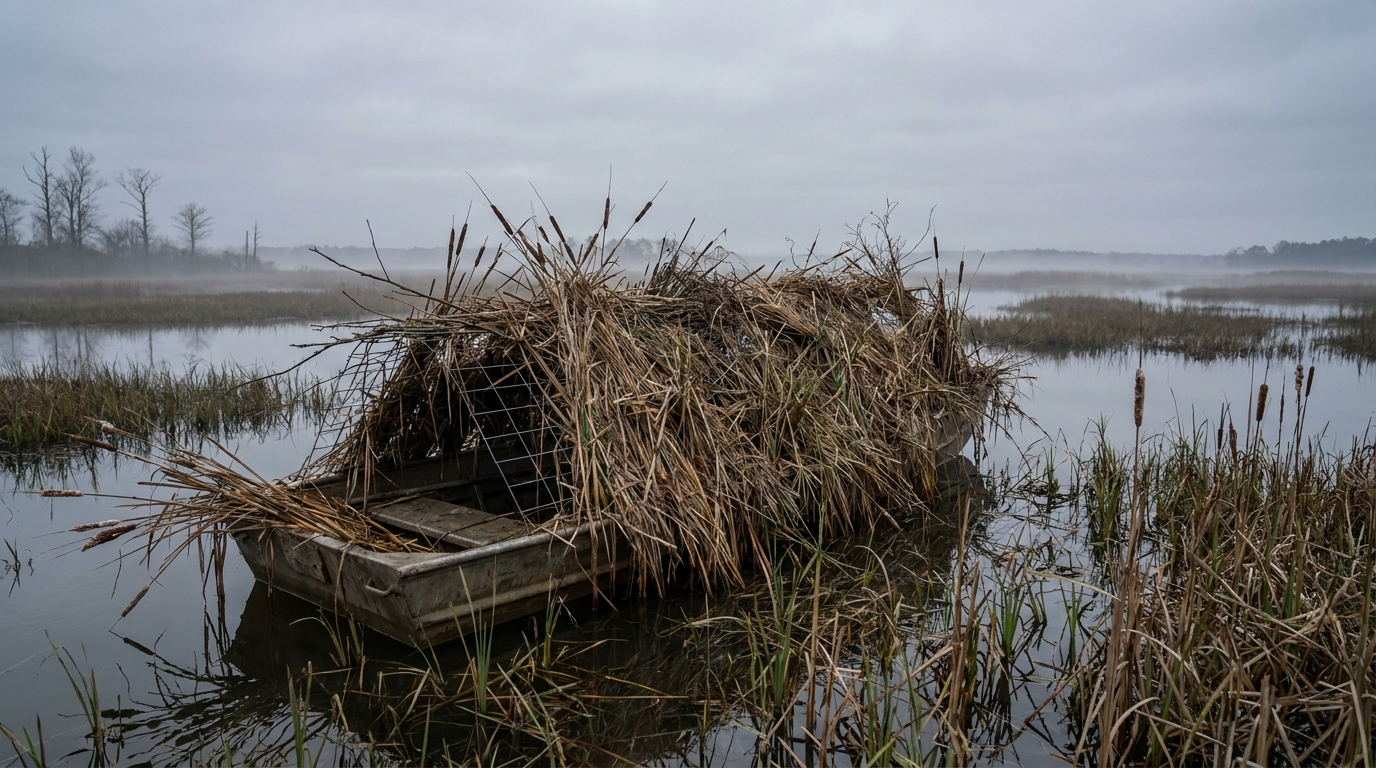
A stock blind kit bolted onto a jon boat, straight out of the box, still reads as one thing to a duck circling overhead: a hard-edged, unnaturally solid shape sitting on open water. Paint doesn't fix that by itself. Neither does a thin skin of grass zip-tied to the frame the morning of opening day. What actually fools ducks is a blind built in layers, brushed with material that matches the water you're hunting, and kept fresh through the season instead of assembled once in August and forgotten.
The Outline Is the Problem, Not the Color
Waterfowl don't need to identify a boat blind as a boat to flare off it. They just need to register it as something that doesn't belong. A solid rectangle sitting low in a cattail slough reads as wrong the same way a cardboard box would — the color underneath barely matters if the shape itself is unnatural. Camo pattern printed on vinyl or neoprene helps at close range and against a dog's nose, but at 40 to 60 yards, silhouette and texture do almost all the work.
That's the part a lot of factory blind covers get wrong. They're cut to fit the boat, not to break its edges. A tight-fitting cover just makes a smaller solid shape. What actually disrupts a duck's read on the situation is irregular height, gaps, and material that moves in the wind the way real brush does.
The Overhead Problem
Ducks that have seen a few decoy spreads don't just look at a blind from the side — they circle, and circling birds look almost straight down before committing. An open-topped blind with brushed sides but a flat, empty interior creates what a lot of waterfowlers call the black hole: a dark, uniform gap that stands out against reeds or corn stubble from directly overhead, even when the sides look perfect. A few branches or a loose lattice of vegetation laid across part of the top — enough to break that dark rectangle without blocking your swing — fixes more blown flares than another coat of paint ever will.
Building the Blind in Layers
Paint First, Brush Second
Start with a flat, non-reflective base coat on the boat and blind frame itself — flat brown, olive drab, or a mottled camo pattern in spray paint made for the purpose. Skip anything glossy; a shine off wet aluminum or fiberglass at first light is visible well past gun range, and no amount of brush fixes a blind that flashes light every time the boat rocks.
The Structural Layer
Before natural brush goes on, most well-built blinds get a layer of something to attach it to — woven wire, hardware cloth, or heavy-gauge camo netting stretched over the frame. This does two jobs at once: it gives you something to zip-tie or wire brush into instead of fighting with a smooth blind rail, and the mesh itself breaks up the outline even in the gaps where you haven't added vegetation yet. Camo netting alone, without any real brush over it, still outperforms a bare painted blind — but it's the combination that actually disappears.
Matching Brush to the Water You're Hunting
This is where a lot of otherwise well-built blinds fail. Cedar boughs look great and smell like a hunting catalog, but dropped into a cattail marsh or a flooded soybean field, they're the wrong texture and the wrong color entirely — a duck that's used to seeing that water every day notices the mismatch immediately. Cut what's actually growing where you're hunting: cattails and phragmites for marsh, native grasses and corn stalks for field spreads, willow and river cane for timber and sloughs. If you're running a boat blind across different water types in the same season, that means re-brushing, not just topping off the same load of vegetation everywhere you go.
Raffia grass and synthetic grass mats are worth keeping in the boat as a base layer or a patch material — they don't die, they hold their color all season, and they work as an under-layer beneath real cut vegetation in spots where live brush would need daily replacement.
Height, Density, and Keeping Your Swing
A blind can be so well hidden that it stops being functional. Brush stacked chest-high on the shooting side blocks the mount, snags a barrel on the swing, and costs shots that a slightly less concealed blind would have converted. Keep the shooting side lower and thinner than the back and sides — enough to break your outline without you having to fight through it to get on a bird. Vary the height across the rest of the blind instead of trimming everything to one uniform line; a flat, even hedge of brush is its own kind of unnatural shape, just a shorter one.
Refreshing Brush Through the Season
Cut vegetation doesn't stay convincing for long. Live-cut cattails and grass dry out, curl, and lighten in color within a few days, and a blind that looked perfect on opening morning can look distinctly gray and dead by the second week if nobody's paying attention. Early season calls for greener material and more frequent swaps; by late season, dried brown and tan cover matches the marsh better than anything green would, and it holds up longer without needing replacement. Plan on checking and refreshing brush at least weekly during a stretch of hunts, more often in hot early-season weather that dries cut vegetation out fast.
Mistakes That Get a Blind Picked Apart
- Trimming every branch to the same length, which creates a straight, man-made edge instead of the ragged line real cover actually has
- Leaving last month's dead, gray brush in place because it's easier than cutting fresh material
- Loading up the shooting side so heavily that mounting a gun means pushing branches out of the way first
- Using vegetation that doesn't grow anywhere near the water being hunted
- Skipping the top of the blind entirely and assuming brushed sides are enough for birds that circle before committing
A Note for Public Water
Public-land boat blinds get busted for a specific reason private ground rarely creates: multiple boats hunting the same water body means ducks get a long, repeated look at what blinds in that particular marsh actually look like. A blind that would pass fine on a private pond can stick out on heavily hunted public water simply because it's built differently than the reed and stump cover birds have already flared off of a dozen times that season. Match your local water, not a photo from a duck hunting forum in a different flyway.
None of this replaces a good decoy spread or a properly scouted spot — a beautifully brushed blind over dead water still gets nothing. But a blind that looks like part of the marsh instead of a boat parked in it turns marginal shooting light into working birds, and it's the difference on the tough late-morning hunts when ducks have already seen every trick once. Check the current lineup of blinds and blind-building gear and camo netting, paint, and other setup accessories before the next brushing session, and layer up — mornings spent wiring brush onto a boat blind before shooting light are colder than they look, so a solid cold-weather layer earns its keep too. Pair a properly concealed blind with a decoy spread built to bring birds in close, and if waders are next on the prep list, wader care matters as much as blind camouflage for getting the whole season out of your gear. For more of what's actually on sale across the rest of the kit, start at the Duck Blind Deals home page.