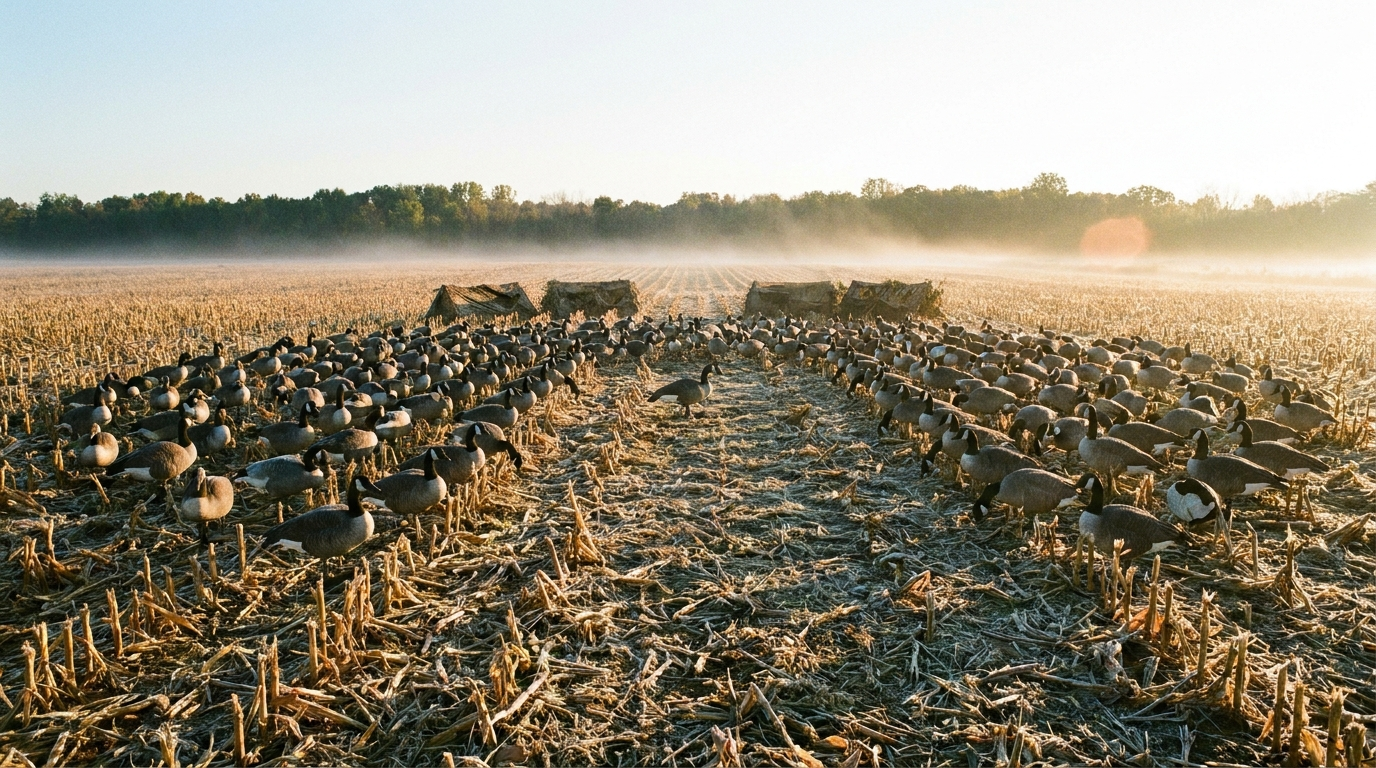
A spinning-wing decoy can pull a goose's eye from close to a mile out on a clear morning. That same rotor, still spinning at fifty yards while a flock cups and commits, is one of the more common reasons a perfect-looking finish falls apart in the last three seconds. Both of those things are true at once, and the gap between them is where most field goose hunters are getting motion decoys wrong — not by using them, and not by avoiding them, but by running them on the wrong clock.
The standard advice you'll hear at the boat ramp is blunt: geese hate spinners, ducks don't, keep them off if you're hunting honkers. That's a decent rule for a hunter who owns one motion decoy and no remote switch. It's also missing the part that actually matters, which is distance. Geese don't have a blanket aversion to rotary motion — they have a strong aversion to unnatural motion at a range where they're reading fine detail. Two hundred yards out, a spinning wing is just a bright flicker that says "something's alive down there." Forty yards out, with a flock committed and dropping into the pocket, that same flicker reads as exactly what it is, and the lead birds flare the whole group before the front rank cups its wings.
Why range changes what a goose sees
Geese work a field in stages, and their eyes are doing different jobs at each one. At long range — the length of two or three football fields — a goose is scanning for movement and contrast against a static background. This is the range where motion sells: flags, wing-wavers, sock decoys catching wind, and yes, spinners, all do real work pulling birds off their line of travel and toward your spread. Power-flagging at extreme range is a long-standing waterfowl tactic for a reason — it's the only thing visible enough at that distance to compete with the real geese already on the ground somewhere else in the section.
Inside a hundred yards, the job changes. Birds locking up are now reading posture, spacing, and how the group in front of them is behaving, not scanning for a beacon. This is where a rotor spinning at a fixed, mechanical rate starts working against you — nothing in a real flock moves like that, and a goose that's already committed has the visual resolution to notice. The fix isn't retiring the motion decoy. It's killing it, or switching it to a wake-style motion, at the range where committed birds start reading detail instead of scanning for contrast.
A distance-banded motion plan
Run motion in three bands, and think of it as a dial you're turning down as birds close the distance, not a switch you flip once:
- 200-plus yards — full motion. Flags on a stick worked hard, spinners running if you're paired with a duck spread, any decoy with aggressive movement. You're trying to be the most visible thing in the section, and subtlety costs you birds you never see commit.
- 80 to 150 yards — downshift to wake motion. Wind socks, bobber-head decoys, and jerk-string ripples read as feeding or nervous birds without the mechanical tell of a spinning wing. This is also the range where you should be flagging less and calling more, matching the pitch and cadence of whatever the approaching flock is doing.
- Inside 50 yards, birds committed — motion off. Spinners killed, flagging stopped, hands still. If you're running a remote switch, this is the moment it earns its cost. A jon-boat blind or layout spread paired for both ducks and geese should have that switch within arm's reach, because the difference between a spinner running and a spinner dead at forty yards is often the difference between a full strap and a flared flock that never comes back that morning.
Building the spread underneath the motion plan
The motion bands only work if the static spread underneath them is doing its job, and early-season field geese don't need — or want — the biggest pile of decoys you own. Resident birds in September are still holding in tight family groups, feeding on a pattern tight enough to set a watch to, and wary of anything that reads as another flock crowded too close to their own space.
For a scouted resident field early in the season, two to three dozen decoys is a full spread, not a starting point. Space them two to three feet apart — closer than that and the spread reads as unnaturally dense; real geese give each other room. Build a wide, shallow U or J shape rather than a tight ball, and leave a genuine gap in the mouth of it — roughly twenty yards across, set about fifteen yards off the blind line. That gap is the landing pocket. It only works if it's empty; a hunter who keeps adding decoys "just to be safe" is the same hunter who watches birds land forty yards short, outside shotgun range, in a hole they made themselves in the wrong spot.
As the season moves from resident birds into migrator staging — cut cornfields filling up with new arrivals through October — decoy counts should scale with what's actually using the field, not with what's in the trailer. Staging fields can hold spreads pushing toward a hundred decoys once numbers on the ground justify it, but that's a response to scouting, not a default. A hundred decoys on a field that's only holding thirty live birds looks exactly like what it is.
Calling less when you're right, more when you're not
The same distance logic that governs motion should govern calling volume, and it ties back to one question: are you actually on the field the birds want, or are you trying to convince them to change their mind? If scouting put you tight on the X — the exact spot birds fed the evening before — the job is closing the sale quietly. Heavy calling on birds that already intend to land there does nothing but give them a reason to look twice. Save the calling repertoire for the birds you're trying to pull off their original line, and go quiet as soon as a flock commits to your spread on its own.
That's the harder discipline for most hunters to hold onto, because a big spread and a loud call sequence feel like more effort, and more effort feels like it should produce more birds. It doesn't. It produces more birds that hang up at sixty yards, work the edge of the pocket, and peel off toward a real flock in the next section over.
Gear that supports the plan
None of this requires exotic gear, but a few pieces make the distance-banded approach easier to execute in the field. A layout blind that sits low and brushes in flat to the stubble matters more for geese than for almost any other waterfowl setup, since a bird committed to the pocket is looking down at exactly the spot a blind occupies — worth checking current layout blind options before the season fills in. A remote-controlled motion switch is worth the cost the first time it saves a hunt, and a solid short-reed or flute call is what carries the long-range work before you throttle back — current goose call selection is worth a look if yours has seen a few too many seasons. Flags, sock decoys, and kill-hole accessories round out the wake-motion band, and decoy and flagging accessories are worth checking against what's actually in the blind bag before opening morning arrives.
Scouting still comes first — none of the motion or spread advice here matters if you're set up in a field the geese aren't using, and scouting the X before you set up is the piece that should happen days before this one. Once the spot is right, the spread and the motion discipline are what turn a flock that's looking into a flock that's finished.
Field goose hunting rewards restraint more than most waterfowl setups do — fewer decoys placed with real spacing, motion that gets quieter as birds get closer, and calling that respects a flock that's already decided. Check the current waterfowl gear lineup before the next scouting trip, and build the spread around what the birds are already telling you, not around what's easiest to unload from the truck.