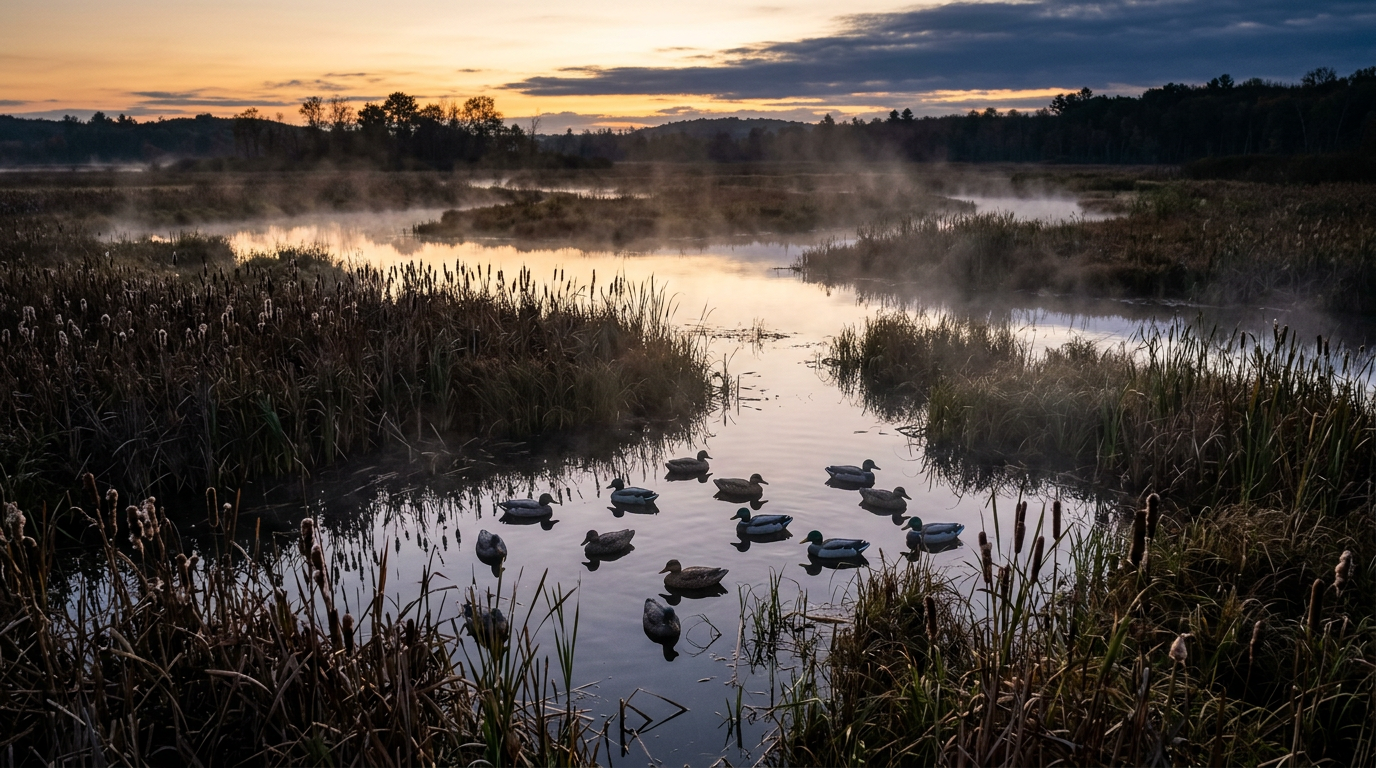
Most "gear you need for duck season" lists put a shotgun and a pair of $400 breathable waders at the top, then work down to decoys and calls like those are the afterthought. That order is backward, and it's why so many first-season hunters spend $1,200 before opening morning and still don't see many birds. Decoys and a workable call are what put ducks in range. The gun and the waders just need to function.
It plays out the same way every fall on public marshes everywhere: a brand-new premium shotgun and stiff, unbroken-in boots paired with six decoys tossed out with no thought to wind direction loses to a used pump gun and two dozen beat-up decoys set up with a real landing pocket. Gear quality matters eventually. On opening weekend, spread and setup matter more.
What Actually Puts Birds Over Decoys
A duck's first look at your spread happens from a couple hundred yards up, and what it's judging is shape, spacing, and a landing hole — not brand names. A dozen decent floating decoys, arranged with an open pocket downwind of your position, will out-perform three dozen decoys bunched into a tight clump with no landing zone. That's a setup problem, not a money problem, and it's the first thing worth getting right because it's free to fix.
Scouting is free too, and it matters more than any single piece of gear on this list. Twenty minutes glassing a pond at last light two evenings before your hunt tells you where birds are actually working — which beats guessing at a public spot from a map every time. New hunters skip this because it feels like a step before the real hunting starts. It's not a step before. It's the part that decides whether the rest of the kit gets used on birds or on empty water.
Steel shot is the other non-negotiable, and it's not optional the way a nicer jacket is. Federal, state, and most refuge regulations require nontoxic shot for waterfowl, full stop. Budget a couple boxes of standard steel loads — 25-round boxes generally run $18 to $30 depending on brand and shot size — and pattern your gun with them before the season, not during it. Shot size matters as much as brand: a box of the wrong size for the birds you're actually hunting is money wasted before you've fired a shell at a duck.
The First-Season Kit, Priced Out
Here's what an honest starting kit costs, split by whether you're borrowing a shotgun or buying everything from zero. These are researched market ranges for entry-level gear, not clearance prices, so budget toward the top of each range if you're buying new.
If you already have a shotgun
- Dozen standard mallard decoys (floating, basic weighted keel): $80–110
- Duck call, single-reed acrylic or double-reed polycarbonate: $25–45
- Neoprene chest waders, budget tier: $100–160
- Decoy bag or mesh sack to haul and store them: $20–35
- Camo layer — jacket and pants, not a full technical system: $80–150
- Federal Duck Stamp (required for anyone 16+ hunting waterfowl): $25
- State waterfowl stamp or small-game license: varies by state, budget $15–35
- Two boxes of steel shot shells: $40–55
That totals somewhere in the $385 to $615 range depending on where you land in each bracket. Call it $450 for a realistic middle number.
Starting from zero, including a gun
Add a used 12-gauge pump shotgun — a Remington 870 Express or Mossberg 500 in decent condition — and you're looking at another $250–400 through a licensed dealer, which pushes the full kit to roughly $650 to $1,000. That's still well under the $1,200–1,500 a lot of "starter gear" articles quote, because those lists assume you're buying premium breathable waders and a semi-auto shotgun on day one. You're not. You're finding out if you like sitting in a marsh before daylight in October.
What Can Wait
This is the part that saves the most money, and it's the part most gear guides skip because it doesn't sell anything.
Spinning-wing decoys. They work, especially early season on puddle ducks that haven't been pressured. They also run $40–80 each and some states restrict their use during specific seasons or on certain public ground, so check your state regs before you build a spread around one. Skip it for season one. Learn wind and spacing with static decoys first — that skill matters more long-term than a motion decoy ever will.
Breathable waders. Neoprene is heavier and hotter to walk in, but it's also more forgiving of the abuse a first-season hunter puts gear through — climbing through cattails, brushing a blind, kneeling on gravel to set decoys. A $500 breathable pair with a mesh puncture or a blown seam by November is a worse outcome than a $130 neoprene pair that just works. Move to breathables once you know how many days a season you're actually hunting.
A dedicated layout blind or boat blind. Plenty of public-land duck hunting happens from natural cover — a downed tree, cattails, a five-gallon bucket seat tucked into brush. A blind is a real upgrade once you've got a spot worth returning to season after season. It's not what determines whether opening weekend goes well.
A duck dog. Obviously worth it long-term, and just as obviously not a first-season purchase. A game bag and a pair of waders to wade out and retrieve your own birds covers you fine in year one.
That's four line items cut before you've spent a dollar on them. Skip all four this season and you've freed up another $150–300 without touching anything that actually determines whether birds finish in the decoys.
The Paperwork Nobody Budgets For
The Federal Duck Stamp is not optional — every waterfowl hunter 16 and older needs one, it runs $25, and it funds wetland conservation that keeps the birds coming back. Most states also require a separate waterfowl stamp or permit stacked on top of your base hunting license, and the cost swings widely by state, so check your state wildlife agency's site before opening weekend rather than finding out at the check station. Skipping this line item is the single most common way a first-season budget quietly goes over — not because the stamps are expensive individually, but because new hunters forget to count them at all.
Spend the Savings on Practice, Not More Gear
Here's the actual return on trimming $600–800 off a first-season budget: spend it on shells and range time instead. A hunter who's patterned their gun with the actual load they'll shoot, and who's put in a dozen practice sessions on clays with someone calling pull at random angles, kills more ducks than a hunter with better gear and less trigger time. That's not a close call. Wing shooting is a perishable skill, and the only way to build it is repetition — which means budgeting for a case of target loads and a few range trips is a better use of gear money than a second, nicer call you'll use twice.
Get the decoys right, get a call you can actually work a hail call and a feed chuckle on, get waders that won't leak, and put the rest of the budget into shells. Everything else — the boat blind, the spinner, the $600 waders — is a second-season problem, and you'll know a lot more about what you actually want by then.
For calls, decoy accessories, waders and bibs, and blind gear currently on sale, check the call selection, pants and waders, blind gear, and decoy and field accessories at Duck Blind Deals. If you're still working out how to blow that call once you own it, the beginner calling breakdown covers real practice drills, and the wader care guide is worth reading before your first pair ever gets wet. Check back at Duck Blind Deals as the season gets closer — inventory and pricing shift fast heading into fall.