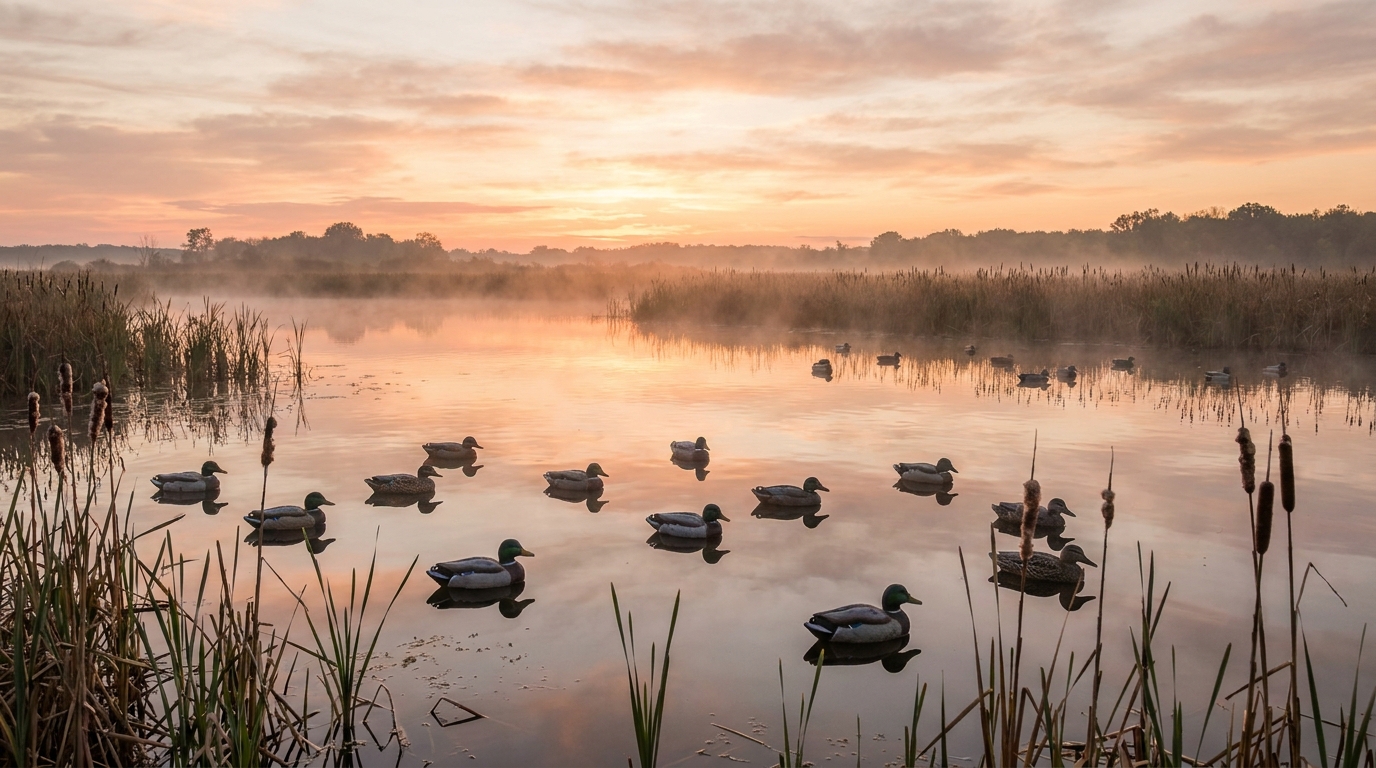
You've seen it happen. Mallards circle the spread four, five, six times, cupped and looking, everything right, and they just won't come down. You call softer. You sit still. Nothing. Then you reach out and give the jerk cord one long, slow pull, and the whole cluster of foam mallards ripples and shifts. The birds tip their wings and drop. That's the jerk rig doing its job, and no spinner or kicker motor produces exactly that result.
What surprises most hunters when they first rig one up: it's almost embarrassingly simple. A folding anchor, 15 feet of marine shock cord, 80 feet of paracord, six snap swivels. Under $15 in materials. You can build a functional setup in 30 minutes on a Sunday afternoon. What takes actual thought is where to position it, how to work it, and when to leave it alone.
What a Jerk Rig Actually Does
The motion a jerk rig creates is different from anything else on the water. A spinner rotates one decoy fast in a mechanical circle. A kicker creates waves. A jerk rig moves 4–6 decoys in unison: they surge toward you, then the bungee pulls them back, and the water between them ripples. From 200 feet up, that looks like a cluster of ducks feeding.
Mallards tip up constantly. Their feet paddle, their tails bob, birds nearby get bumped and shift around. A jerk rig copies that cluster of activity better than any motor can, because the motion is irregular. You're pulling by hand, not on a timer. That randomness reads as real to an educated duck in a way that a 400 RPM spinner rotation does not.
That irregularity also means jerk rigs age better through a season than any automated system. Ducks learn patterns. A motor running the same RPM on the same arc for 60 days of the season starts to look like furniture to late-season birds. The jerk rig never gives them that pattern to learn.
The tradeoff: you need a hand free to work it. That's the first thing to set down when birds are committed and on final approach.
Building One From Scratch
Six items:
- 15–20 feet of 3/16" marine shock cord. Must be marine rated — hardware store bungee breaks down fast in cold water.
- 80–100 feet of paracord or 80 lb braided line
- A 3–5 pound folding grapple anchor, or a concrete-filled coffee can with an eye bolt in the top
- 6 snap swivels, size #1 or #2
- A short wooden dowel or 8-inch section of PVC for in-blind cord storage
- Optional: a paracord wrist loop at the pull end so you don't drop it in the dark before shooting light
Tie the shock cord to your anchor. At the free end of the shock cord, tie on the main paracord. Clip snap swivels every 4–5 feet along the main line. Tie the far end to the dowel. That's the rig.
Clip decoys straight through the keel eye to each snap swivel. No drop cord between swivel and decoy — a direct clip keeps the line on the bottom and out of your dog's path when she's running retrieves. If you want more movement from a particular decoy, pull the keel weight and let it float free on the swivel. Keel-less decoys tip and bob more dramatically when the cord pulls.
Run a test pull in your backyard at full cord length before the first morning of the season. Cold water stiffens poor-quality shock cord, and you'd rather find that out in September than at 5:30 AM on opening day.
Where to Put It in Your Spread
The jerk rig belongs in your landing zone — the open water pocket where you expect birds to touch down. Not at the far edge of the spread. Not tucked beside the blind.
Set it 25–40 feet out, with the cord running roughly perpendicular to the birds' approach angle. When you pull, the decoys slide toward you and the water ripples outward. That motion looks most natural from an incoming bird's perspective when it crosses the line of approach rather than moving directly toward or away from them.
The anchor goes at the far end of the string. Bungee sits between the anchor and the nearest decoy. That spring load creates the drift-and-return action. If you anchor at your end and pull away from it, you get no snap-back when you release. The bungee has to be on the anchor side.
For spreads bigger than 20 decoys, two rigs running 6–8 feet apart outperform a single cord. When you pull them together, the water movement reads as a bigger feeding group.
Calm Water Is When This Matters Most
Spinner decoys work great in wind. When it's blowing and the water's already choppy, motion is everywhere and ducks expect it. The spinner stands out at range and pulls birds from 400 yards.
On a flat, dead-calm morning, a spinner can backfire. The rotation is mechanical and constant. Late-season birds have seen thousands of them. A jerk rig ripple on still water carries 300 yards and looks like nothing except ducks feeding. The irregularity of hand-pulled motion is the whole point.
The flip side: when the wind is strong and the surface is already churning, there's less reason to run a jerk rig. Natural chop covers what it would provide. Save your hands that day and let the decoys rock in the waves. The rig earns its keep on the calm days.
If you hunt the same marsh consistently, you'll notice jerk rigs holding up better through the season than spinners. Ducks get educated on the rotation. They don't get educated on something that moves differently every time.
Working the Cord
The instinct when birds appear is to start working the rig hard. That's the wrong move.
Pull when birds are distant and checking your spread, 150 yards or more. One long, slow pull every 20–30 seconds. You're making the spread visible and interesting from altitude.
As birds begin to circle, slow down. One pull per pass over the decoys. You're confirming the spread is alive without overselling it. If they're already interested, you don't need to get their attention — you need to keep it.
Watch the birds' bodies, not just their distance. When mallards come off high and start dropping altitude on the downwind side, that's not another circle. They've decided. Set the cord down. Pick up your call or your gun. A jerk at that moment is more likely to flare them than help.
Teal are different. They come in fast and commit quickly, and aggressive motion seems to pull them faster than the measured pulls that work on pressured mallards. When you're hunting September teal, work the rig harder than you would for November mallards.
The hunters who get the most out of a jerk rig treat it like a call. Match the intensity to what the birds are showing you, not to how anxious you are.
Against Spinners: Run Both
These aren't competing tools. Most effective duck hunters run both.
A spinner pulls birds at range — 400, 500 yards on open water. The jerk rig works the close-in game: keeping circling birds interested, giving them the final visual that makes them drop. Kill the spinner when birds are inside 50 yards if they look edgy. Leave the jerk rig going.
Late season is when the jerk rig earns more than the spinner. By January in most flyways, the birds that are still around have been hammered. Spinner decoys get ignored or actively flare educated ducks. A jerk rig stays effective because no two pulls are the same.
A Note on Divers
Scaup, ringbills, redheads, canvasbacks — they all respond to jerk rig motion. Position the rig differently for them, though. Divers don't cup and drop the way mallards do; they raft up and skid in from a distance. Put the jerk rig at the edge of your open water rather than the center landing pocket.
Slow it down for divers. A pull every 30–40 seconds is plenty. Divers key on water movement more than on individual decoy motion. A feeding flock moves steadily.
Commercial vs. DIY
Tanglefree makes a solid EZ Rig. Rig'Em Right has a version that stores cleanly on a cord wrap. Heyday's Lifetime Jerk Rig has a molded handle that works well with heavy gloves. Any of them do the job fine. So does the setup you built for $12 in an afternoon.
Jerk rigs are one of the few pieces of waterfowl gear where price doesn't buy you anything. The physics are simple, and simple doesn't improve much.
What does matter: the shock cord has to stretch and snap back cleanly in cold water. Soak your rig in 42-degree water before opening day. If the bungee is stiff and won't extend easily, the recoil dies and the motion goes mechanical. Test it in the cold before you need it on the marsh.
Check Duck Blind Deals for decoys, waders, and layout blind gear before season opens. Brands like Avery and Tanglefree run late-summer sales, and the quality stuff goes fast once migration reports start showing birds moving.